In spite of the huge influx of automated data entry tools in the market, manual data entry is here to stay. While it does sound like a bold statement in favor of manual data entry services, anybody who is in data entry business will agree with it. It is simply because primary data cannot be collected accurately without manual data entry services. As it has to be collected from a wide variety of sources, automated data entry tools don’t prove to be sufficient without manual intervention.
Having underlined the significance of manual data entry services, one must admit that it has its own share of challenges. Whether it is errors in capturing data, depicting the same information in ten different ways or delay in delivery of services, businesses have to be on their toes to avoid these inconsistencies. Even a single error in the primary data may cost you dearly. But all the challenges of manual data entry services can be dealt with by following a structured approach. If manual data entry is not your core business, it is best to outsource manual data entry services to a specialized service provider. Even in doing so, you should make sure that your outsourcing partner follows the steps discussed below. It not only gives you accurate manual data entry services but also frees up a lot of time and resources for you.
Choose the right services provider
In manual data entry services data has to be captured from a wide variety of sources. It means that you should have access to a team of dedicated data entry professionals that works exclusively for you. Unlike project outsourcing models where the outsourcing partner takes up the work and sends you the completed end product at the end of the project, a dedicated team is an extension of your in-house team. You can collaborate with your dedicated team in real time. This relationship works in our favor as you can give feedback and get the wrong entries corrected then and there.
Hire the most suitable skill sets
Whether you keep the manual data entry process in-house or you outsource it, your first priority should be to hire the most pertinent skill sets and in the right number. When you have access to the right talent with ample experience of manual data entry, you can rest assured about the quality of services. Outsourcing gives you the leeway to hire as many resources as you require at a fraction of the price that you would spend to hire local talent. Interviewing the resources personally and giving them tests is the best way to hire the most suitable skills.
Provide your resources with appropriate tools
As manual data entry is not all about pen and paper, you need to have access to the most appropriate software and hardware used in the process. For example to scan data from various sources you should opt character recognition and intelligent character recognition software handy. Similarly there a host of other hardware requirements that must be fulfilled to get quality services. If you do manual data entry in-house, you will have to spend on all these overheads. This not only dents your budget and finances, but also impacts the bottom line of your business. Outsourcing, on the other hand, gives you automatic access to the latest tools and technology at no extra cost.
Double check the entries
Adopting standard operating procedures does limit the number of errors in manual data entry, but inconsistencies do creep in due to varied sources of data. Hence, to make sure that every entry is accurate and as per the data entry guidelines, you should go in for a double layer of assessment. Before finalizing the data you should get it checked by supervisors. In an outsourcing environment, most of the vendors have a dedicated quality check team that supervises the data entry process.
Whether you outsource your manual data entry services or not, you should have all these provisions in place to ensure that there are no errors or inconsistencies in your data. Drop a mail to info@data-entry-india.com, if you are planning to outsource manual data entry services.
In today’s business scenario, customer data is available in more forms than ever before. It is a good thing on one hand and an overwhelming challenge on the other. Good, because there is no dearth of relevant information and challenging, for the simple reason that businesses often find themselves at a loss when they have to identify trends within a data set. This is where data enrichment comes in as a handy tool. It is essentially the process of merging multiple data sources that enables business to build strong data profiles that eventually help them make well informed decisions. On the surface the process of data enrichment might sound complicated, but if you follow a structured approach and industry best practices, you can easily reap its benefits. Let’s find out the best practices associated with data enrichment services.
Healthcare providers around the world are struggling to manage the wealth of information contained in laboratory findings, medical images, and a whole lot of medical data. Sorting, analyzing and collating this data to add value to patient care is a daunting task that calls for well trained resources. Obviously, finding and hiring these professionals takes a toll on your financial resources as well the core business of patient care.
Every business irrespective of its size has to deal with a plethora of documents in the form of accounts, product details, user manuals, employee details and what not. Imagine the difficulty a business would have to face in retrieving pertinent information from these documents if these are not standardized. Especially if the documents are in MS Word format, the challenge to deal with the information will be enormous. For this simple reason, companies and entrepreneurs spend of a lot of their time and resources on MS Word Formatting services. But there is a smarter way to get bespoke results without engaging your own resources in this tedious and repetitive task – offshore MS Word Formatting Services.
Offshore MS Word Formatting Services not only deliver customized results within a quick turnaround time, but also offer a bunch of benefits that would never have imagined. We’ll talk about these unheard of advantages of outsourcing MS Word Service in a bit, let’s find out what all is involved in MS word formatting.
There are a whole lot of processes involved in MS Word Formatting. It could be a simple process like caption numbering and labeling or an intricate one like data conversion; everything comes under the purview of MS Word Formatting. Editing, table formatting, image placement, footnote styling, indexing, bookmarking, and header/footer setting are some of the important MS Word Formatting services.
Now let’s come to the main point of what exactly you gain by offshore MS Word Formatting services. Apart from getting the desired results, there are a lot of indirect benefits that not only make your operations more agile, but also keep your ahead of competition.
Easy Access to the right Skill Sets
When you opt for offshore MS word formatting services, you can pick and choose the most pertinent skill sets for your requirement. Your offshore vendor is obliged to give you easy access to bespoke talent. This is a huge benefit that absolves you of the responsibility of finding and hiring employees. This means that you won’t have to spend your hard earned dollars on finding and hiring the right resources.
Boost in productivity
Your offshore vendor becomes your partner in providing bespoke services and the remote team works as an extension of your own office. This is a great working relationship in the sense that you don’t have to worry about infrastructure, employee benefits, hardware, software or anything else and still you get services of experts. In such a win-win scenario the productivity of your on shore office can only go up.
Focus on core business
Apart from giving you access to the right talent and boosting your productivity, offshore MS Word Formatting services also enable you to focus on your core business. This is a huge advantage that further translates into better customer satisfaction and enhanced bottom line. If you have this edge over your competition, you can always have the lion’s share of the market and become a leader in your field.
Entrepreneurs and business owners often limit the benefit of offshore services to cost saving, but if you delve just a bit deeper, you will realize that this business practice is the door to huge opportunities.
Who else other than startups and small business will vouch on the power of knowledge. It is the creation of knowledge and ability to implement it that emboldens an entrepreneur to launch a startup. While starting a new small venture is easy, sustaining it as a business is the difficult part. Studies show that at least 60% of startups run out of gas within the very first year of operations. Financial constraints notwithstanding, it is the inability of entrepreneurs to reinvent themselves that is responsible for such a phenomenal failure rate. Here the tricky question is why are new small businesses unable to rediscover themselves? A close look at the success stories on new ventures will reveal that they are able to derive new insights from their existing data. And how do they achieve this feat? The answer is data mining.
What is data mining
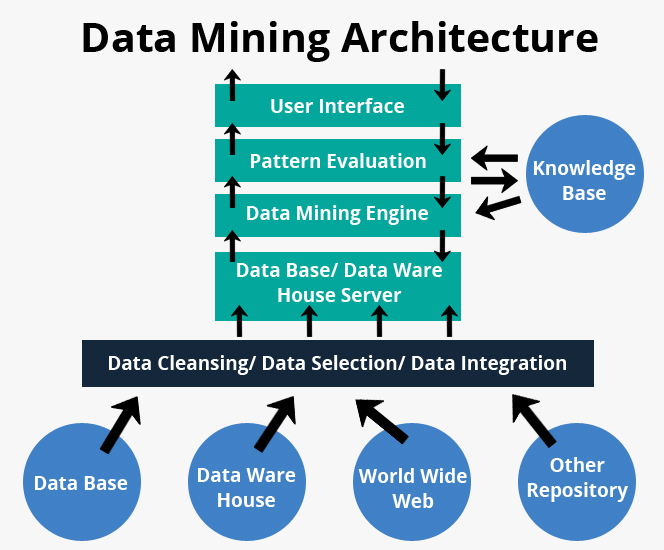
It is essentially the process of identifying patterns within a large database of information using certain software and tools. By applying this process to their data startups can gain valuable insights into customer behavior, sales, customer experience, market position vis a vie competitors and a host of other aspects of business. In turn this readily available knowledge helps them foresee challenges and make timely decisions. Data mining also involves data collection, warehousing and data processing using the latest statistical and algorithm based tools.
Preparing for data mining
Now that you are aware of the potential of data mining in ensuring success of small enterprises, you would obviously be eager to take the plunge. But wait. Jumping into the bandwagon of data mining will be of little consequence unless you are fully prepared to do so and have a fair understanding of the sub processes involved in it. To make the most of this potent tool you need to have an in-depth understanding of your target market and competitors. Here’s what you need to do before testing the waters:
Strategize: Make a long term strategy of what exactly you want to achieve by taking up data mining as a business practice.
Keep customers at the helm: Identify your target audience and carve out a plan on how exactly you want to enhance your customer experience.
Assess your competition: A thorough analysis of your competitors is a must to understand their strengths and weaknesses.
Develop strong messaging: It is a rather meticulous exercise of identifying what exactly your potential buyers are looking for and then coming up with a message to engage them.
Acquire technology: You need to have access to the technology that allows you to enhance your customer experience and engagement. If analytics and related tools are too expensive to acquire, find a vendor that can procure the necessary systems in a cost effective manner.
Once you are fully prepared to leverage data mining, your next step should be to identify the technique that suits your individual needs. As data mining equips you with new knowledge derived from your data, you should have a clear understanding of what exactly you want to achieve from newly acquired insights. This approach also helps you to pinpoint the data mining technique that would work for you. Now, let’s look at the different techniques available and what do they offer in terms of process and outcomes.
Data mining techniques
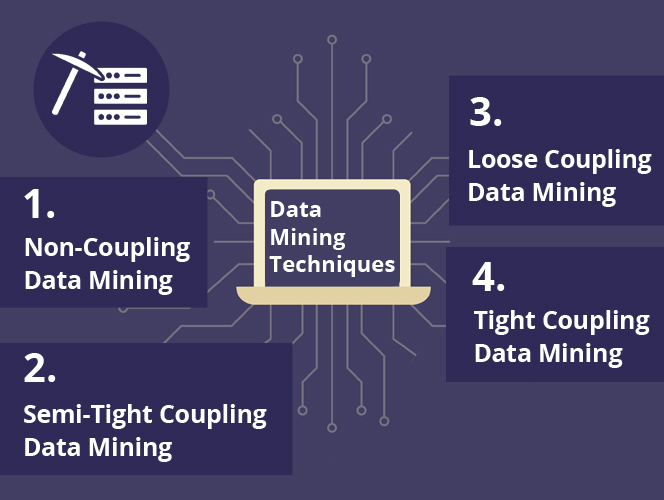
Industries across the board rely on four different types of data mining techniques to drive growth:
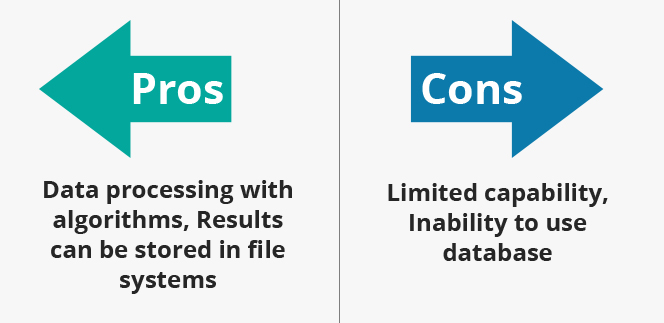
This technique is ideally suited for simple data mining processes as it collects data from predetermined sources. In terms of architecture, non-coupling data mining does not rely on resources offered by database. To process the data it uses algorithms designed to meet certain goals. One big plus of this technique is that it allows you to store the results in any file format. On the flip side, its inability to leverage the functionalities of database makes it a weak data mining technique.
Loose Coupling Data Mining
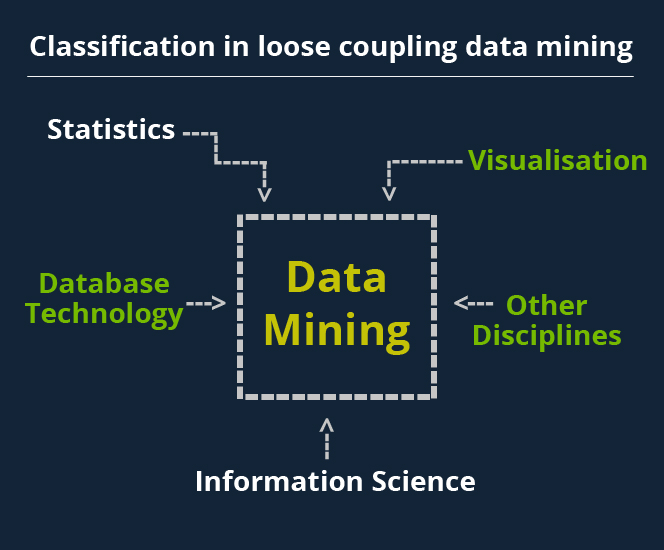
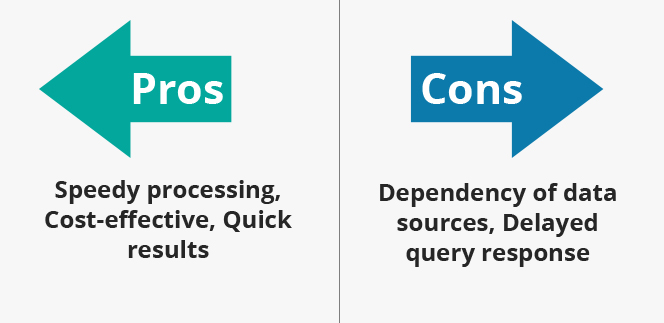
Loose coupling data mining is considered to be a very efficient and agile technique. This is simply because of its ability to collect and process data from any segment of your database. This technique can also use the different functionalities offered by database and data warehouse to augment processing. You can store the results in your file system or within the database. As loose coupling data mining can retrieve data from any resource, it adds to its agility in delivering results. This technique also proves to be cost-effective as data localization is not required. However, this advantage can become a stumbling block as it can delay the query response time.
Semi-tight Coupling Data Mining
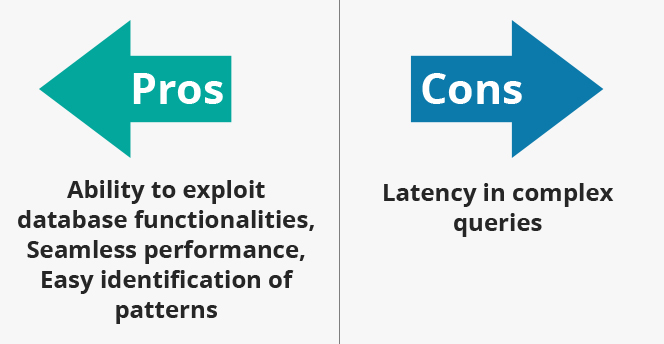
This technique is primarily meant for identifying patterns within the data being mined. Semi-tight coupling method can make the most of warehouse system components and functionalities to speed up mining activities like indexing and aggregation. It also allows you to store certain results within the database. As results are stored within the database or data warehouse, it can lead to latency in complex query resolution.
Tight Coupling Data Mining
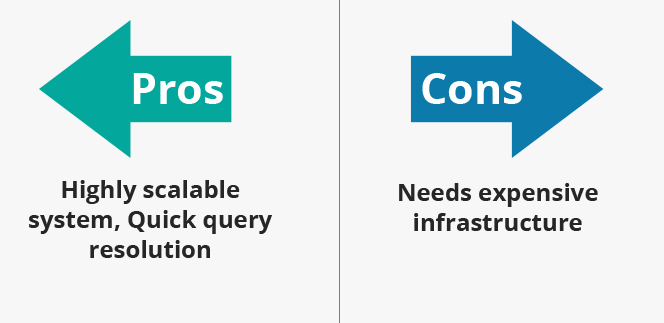
In tight coupling data mining database or data warehouse itself acts as an information retrieval tool. The architecture is complex, but offers a lot of flexibility and scalability in terms of driving results. However, this technique calls for expensive infrastructure and data security provisions. As data is copied over, complex query resolution is becomes speedy and accurate. Being a complex system, it proves to be an expensive proposition for startups.
Validation and Enrichment
Applying the right mining technique as per your individual requirements and budget can make every startup a sustainable business. However, to really leverage the power of data mining you need be hands on with data validation and enrichment processes. These processes not only help you measure the performance of your data mining techniques, but also give you the leeway to tweak your mining model thereby enabling you to drive the desired results. If you are not an authority on data validation services, outsourcing these to to a specialized vendor is your best bet. Data validation measures data mining on three attributes – accuracy, reliability and usefulness.
Accuracy: Checking data for missing or approximate values and ensuring that data has not altered in the processing phase.
Reliability: Measuring the performance of data mining vis a vie changing data sets and making sure that the patterns are uniform irrespective of technical information provided in the data.
Usefulness: Applying matrices to measure the usefulness of the results.
Data Enrichment
It is the process of improving and enhancing raw data into a valuable business commodity that enables entrepreneurs to make well informed decisions. There are a host of service providers who can deliver bespoke data enrichment services to you.
The 6 main attributes of data enrichment are:
Data Fusion: Integration of data sets with same real world representation in a precise and useful manner.
Name Recognition: Identifying people, businesses, cities and entities with similar names and classifying them into categories.
Data Disambiguation: Standardizing textual data extracted from different systems.
Segmentation: Grouping data into segments depending of similar features.
Data Imputation: Estimating and imputing values for missing or inconsistent data.
Data Categorization: Labeling data according to preset categories.
Data mining: Helping startups succeed
Take a look at the top ten startups of 2018; whether it is Rubrik, Ripple, Bird or Lyft, you will find one thing common among them and that is, these ventures never stopped deriving new insights from their data. This simply means that for a startup to be successful it needs to treat data as a valuable commodity and create strategies to turn this raw information into valuable insights. While earlier it was difficult for small businesses to do so given the constraints of meager resources, now there is no dearth of techniques and services that make data mining accessible to startups. In the present scenario you can outsources data mining services, data validation services and data enrichment services at affordable prices.
Data mining services not only enable small businesses to build customer relation strategies that work, but also bolster their sales and marketing. In addition to this, startups are able to allocate their resources in a better way and mitigate risks.
Hope this write up gives you an idea of the efficacy of data mining in sustaining your fledgling business and helps you in applying this technique.
The sheer mention of the words ‘Data Entry’ evokes a series of visuals in the mind of a layman. Keyboarding numbers repetitively and a computer screen invariably occupy our imagination when we hear these words. But in fact, data entry is much more than that and in this write up we will explore everything related to this very common but often misunderstood term.
What is data entry?
To get to a comprehensive definition of data entry we will have to first understand data. Simply put, data is a set of values of subjects that may vary in terms of quantity or quality. These values don’t hold any good on their own unless these are collected, measured, and analyzed within a certain context which is key to what value will be collected in what format. Only after going through this rather rigorous process data becomes useful information and knowledge.
With this understanding, data entry can be simply put as the process of collecting data in a certain format.
Types of data entry
Broadly, data entry can be classified into two major categories namely person-based data entry and machine-based data entry. While the former relates to the collection of data in handwritten formats in the absence of a machine, in the latter data is punched in an electronic device such as a computer, tab or any other data collection machine. As machine-based data entry involves an electronic device, it is also referred to as electronic data entry and its origin can be traced in the late 70s and early 80s. In modern times almost all sorts of data is collected in the electronic form, thanks to the easy availability of computers and special data collection devices.
Data entry in computers
Today computers have become the preferred choice of businesses and organizations to capture data as these modern machines can store a wide variety of data in different forms and have built-in programs to analyze it. Organizations can easily install customized software in their computers to meet their specific data analysis and management needs. Keyboarding data in computers is also very simple and easy and does not require high-end skills.
Data entry services
Data has always been an important tool to reach well-informed decisions and get valuable insights into a specific domain. But over the last couple of decades, data has assumed enormous significance, thanks to the rise of information technology and related industries. Today, even a school student generates and consumes a huge amount of data every day. Imagine how much data industries, businesses, and their customers are generating in a day. This data is a huge opportunity for businesses to understand their customer behavior and get insights into their industry. Capturing this humongous amount of information calls for trained resources, software, hardware, and infrastructure. This situation has created a new business domain – data entry services.
Over the last decade data entry services have evolved in a big way and now offer bespoke solutions to industries across the board.
We sincerely hope this write up adds to your knowledge and understanding of data and data entry services. We will update this blog soon with new information; stay tuned to delve deeper in the world of data entry services.
SunTec Digital, the digital publishing and content transformation wing of SunTec India, will be at the centre of the publishing universe in March at the Olympia for the London Book Fair.
The London Book Fair is the global marketplace for rights negotiation and the sale and distribution of content across print, audio, TV, film and digital channels, having just celebrated its 45-year anniversary in April, 2016.
Staged annually, LBF sees more than 25,000 publishing professionals arrive in London for the week of the Fair to learn, network, and kick off their year of business.
SunTec Digital’s expert team will be present at Capexil, stand #3A10 in Tech Zone, showcasing their ingenious eReading platform, ‘OneRead‘ from the 14th to the 16th of March, 2017.
Meet SunTec Digital Experts
If you are attending The London Book Fair 2017, and want to discuss the benefits of transformation of content ecosystems in the digital age, schedule a meeting with our representatives. They will be available at the Tech Zone, Capexil stand #3A10. For more information, write to us at info@data-entry-india.com.
This is a continuation of our earlier post, SEO Best Practices for your eCommerce Store – Part I – wherein we essentially discussed how you can optimize your eCommerce site for search engines, making it easy to crawl, showing authority (with backlinks and content) and making keywords you want to rank for, relevant.
Getting your store to appear in organic search results on Google or Bing, though difficult and long-winded, but is certainly not impossible as it may seem, sometimes.
SEO Strategies to Enhance Your Product listings
Once you attain a clear understanding of the challenges faced by your eCommerce site, you can move forward by implementing the following SEO strategies that can help your product listings get ranked higher on search results.
Create compellingproduct descriptions: Don’t make the same mistake that most eCommerce store owners make, i.e. using manufacturer’s product descriptions. Search engines consider this to be a case of duplicated content, which might attract penalties. Product descriptions provide you with an opportunity to create unique, informative and compelling sales copy that boosts sales and conversion rates.
Using long tail keywords: Long tail keywords are highly targeted keywords having three or more words. People using long term keywords usually know what they are searching for, therefore a product page that has been optimized for long term keywords has a greater probability of attracting customers and converting them into sales.
Includecustomer reviews: It has been estimated that product pages having customer reviews are successful in converting over 58% more visitors, while boosting revenue by over 62%. This is because customer reviews help in establishing credibility and act as a social proof for potential buyers. Product pages featuring customer reviews rank higher since Google rewards pages that are frequently updated with unique content.
Make navigation intuitive: Your website’s architecture can be incremental in attaining higher rankings and providing great user experience. So it is best to organize your product pages into appropriate categories so that it facilitates easy navigation.
Integrate social media on your product pages: Google rankings play a major role in influencing the quality and amount of social media signals since they reflect a page’s relevance. It is advised that you add social sharing buttons for popular social media platforms like Facebook, Twitter, LinkedIn, Pinterest, etc., to your product pages in order to allow your customers and prospects to share product information with other potential customers.
Optimize page load speed: As many as 40% of visitors will leave, if your product pages don’t load within 3 seconds, and approximately 80% of your customers won’t return to your site if they are disappointed by your site’s load time. Page load time can be optimized by employing lazy loading, compressing product images and fixing coding issues.
Write appealing metadata: Your product pages need unique, compelling Meta titles and descriptions incorporating popular keywords to increase its visibility. It is considered one of the most crucial aspects of on-page optimization. It is important to note that metadata is usually the first thing your potential customers come across, while making a Google search, so it is best to provide your potential customers with a compelling copy of product description that prompts them to make a purchase.
Include rich snippets: Snippets in the form of coded data can be included in product descriptions to provide more information about the product such as price, availability, etc. Incorporating snippets result in better Click-through-rates (CTR) as well as higher rankings on search results.
Includeproduct images: Quality of your product images have a direct relationship with what your potential customers feel about your products. Always include visually appealing images to help your customers make informed purchase decisions. Also, tag these images with appropriate metadata so that they are easily searchable.
Use search-friendly URLs: Your product page URL’s needs to be unique and should be optimized for main keywords. Appropriate URLs tell search engines what the page is all about while providing visitors with helpful product information.
Optimize your eCommerce site for mobile: Mobile shopping has reached its peak and it has made it important for you to make your eCommerce store mobile friendly. According to recent findings, over 30% of all eCommerce sales in US these days, take place using a mobile devices. Over 30% of customers using mobile abandon a transaction if a website is not optimized for mobile. Also, as many as 57% customers will never recommend a business having non-responsive websites. Hence, it is wise to use a responsive design for your website in order to create a seamless shopping experience for your customers across all platforms.
Improving your eCommerce site’s performance is an ongoing process requiring you to stay updated with SEO best practices at all times. It is advised that you regularly test your website for errors, perform keyword and competitor research, observe Google’s algorithm updates, and make the required changes to optimize your eCommerce website and provide your customers with a great shopping experience.
Looking for some help to optimize your eCommerce store? Write to us at info@data-entry-india.com and our experts will get back to you shortly.
We all know that Search engine optimization (SEO) can be the real deal breaker for any website and it is even more critical for the success of eCommerce websites, as SEO plays a major role in attracting, converting as well as retaining potential customers. However, performing SEO for eCommerce sites is highly complicated due to the presence of hundreds and thousands of product listings, which require regular updating. This is the reason why following a set of SEO best practices becomes essential in order to make sure that your site always performs at optimum levels.
Statistics Say It All
There’s no scope for errors when it comes to product pages optimization for your eCommerce store, especially when you are aiming for something higher than simply getting to the top spot on Google search results. Preferably, getting to the top three spots can significantly drive traffic to your eCommerce website. According to recent findings, on an average, sites ranked on first page of Google keyword search, attain an average click through rate (CTR) of approximately 71.3%. Whereas sites appearing on second and third page, combined – only get a CTR of 5.59%.
What is even more alarming is the disparity that can be seen between the top spots on first page of Google search results. The search result holding first position receives on an average 31.24 clicks, whereas the second position holder receives only 14.04 clicks on average (a drop by more than half of the first position). We could dig into the stats even deeper. However, we believe these statistics are enough to provide you with an idea of what all you will be required to put in to win the SEO battle for your eCommerce website.
Review, Research and Optimize
Analyze data, research keywords as well as competitors, and implement the changes required, based upon your findings. Failing to do so, guarantees that your listings won’t be successful in getting the first position on first page of Google search results. While review, research and optimization must continue on a regular basis to be successful, you must focus on three core areas before you can begin performing SEO to get your listings ranked higher on Google search results.
SEO assessment: Begin by performing a comprehensive assessment of your website, so as to identify SEO shortcomings. While it is advisable to perform assessment for your entire website, you must pay special attention to your product pages. This is where majority of the flaws are detected and are also imperative to your website’s performance. Tools such as Screaming Frog can be used to crawl through your images, CSS, links, etc., so that you can identify errors, missing tags, duplicate entries and other issues that can have a negative impact on your site’s rankings.
Keyword research: Keyword research plays a major role in getting your website ranked higher. Targeting wrong keywords can lead to driving low quality traffic and lower sales. Using the right keywords strategically can attract qualified customers and also boost your sales and conversion rates. Perform your research based on keyword relevancy, ranking difficulty and search volume. You may use long-tail keywords relevant to your products, as they have a higher exact-match search volume as well as a significantly lower difficulty ranking when compared to the competition.
Competitor research: Analyze competitors’ website to prepare a list of keywords that are being used by them. Perform research to determine the keywords you wish to compete against. Also, figure out the architecture used by these competing websites. Primarily focus on their product pages to attain better insights about ways to organize your websites navigation.
When it comes to implementing and incorporating SEO Best Practices for your eCommerce Store, it’s definitely not possible to cover everything in one article. So, please continue with our post in the next article: SEO Best Practices for your eCommerce Store – Part II
If you have any tips or advice, you think our other readers should know about, please share them as a comment to this post. If you are looking for some help to optimize your eCommerce store, please write to us at info@data-entry-india.com and our experts will get back to you shortly.
A number of financial records, forms, questionnaires and other documents which fill your office cabinets hold a vast amount of critical information that can help you make key business decisions. From startups to large-sized organizations, businesses understand the importance of internal data that can provide valuable insight and help in streamlining business processes.
Welcome to Data-Entry-India.com! We would love to hear your suggestions, ideas and comments. However, please do not spam, use profane language or post slanderous remarks, etc. All comments on this blog are moderated.
 +1 585 283 0055
 +44 203 514 2601
 +919311468458