


The annotation market has matured. Today, nearly every major service provider guarantees high accuracy rates, enterprise-grade security, human-in-the-loop QA, and flexible capacity. That elevated standard of service is good news for buyers, but it raises a new question for anyone considering data annotation outsourcing:
When most providers meet the baseline expectations, how do you choose the right one?
The answer is operational fit, i.e., how well a partner handles your specific data types, complex edge cases, and evolving labeling guidelines. To find out who can deliver, ask the right questions and evaluate the right parameters that reflect modern data annotation needs, not traditional ones.
First, the Baseline Every Data Annotation Provider Should Meet
Before you assess operational fit, confirm the basics. If a data labeling company does not have any of the following, they shouldn’t make your shortlist.
- A Documented QA Process: Every label is reviewed by at least one person other than its annotator. A share of each batch is labeled by multiple annotators to measure agreement (IAA), and labels are checked against a gold set of known-correct answers.
- Verifiable Security Certifications: ISO 27001 and SOC 2 Type II at a minimum, plus HIPAA or GDPR if your data requires it.
- A Managed, Trained Workforce: Find out whether annotators are in-house, contracted, or crowdsourced. Also check whether the provider subcontracts work to third parties (if they do, that is usually not a good sign).
- Capacity to Scale: The provider should be able to show how it ramped up a past project, including how long it took to onboard and train new annotators.
- Committed Turnaround Times: Find out their delivery timeline average for data types and volumes similar to yours.
- Relevant Project History: Look for case studies or references from projects in your industry or on your data type.
Treat this list as a pass/fail filter. Every provider that passes moves on to the evaluation below.
Shift Your Focus from General Accuracy Claims to Edge Case Precision
Suppose 95% of a dataset is routine and 5% consists of edge cases, meaning rare or ambiguous records. A hypothetical vendor that labels every routine record correctly but only half of the edge cases would report 97.5% accuracy. But that figure doesn't account for half of the edge cases the model must learn to make the right decisions amid ambiguous real-world circumstances.
This doesn't mean you shouldn't trust the accuracy figures vendors cite. You should, because those figures reflect the vendor’s body of work, experience, volume, and project diversity. But don't compare vendors based only on their headline accuracy number.
Ask: what is their accuracy rate on the hardest cases in my training dataset? Design the pilot around this question, and you will find it much easier to rate and evaluate data annotation companies.
For the Pilot Project/Annotation Sample, Give them Data that Represents Your Edge Cases
A data annotation pilot becomes a selection tool when it measures data annotation quality and accuracy on the records that carry the risk. So, make the pilot dataset count.
- Include Edge Cases on Purpose: Choose samples that are ambiguous, noisy, or rare.
- Keep an Answer Key (Gold Set): Have your own team label a small subset first, so you can score the output independently.
- Watch How the Vendor Handles Ambiguity. The best signal in a pilot is the questions. Add records your guidelines do not cover, and watch whether annotators flag them and how the vendor resolves them.
- Change the Schema Mid-Pilot: Redefine one class and observe how the vendor retrains annotators and relabels earlier batches.
- Track How Many Times Your Guidelines Were Challenged: If the vendor’s suggestions improve or clarify your labeling guidelines, they know what they are doing.
Ask How AI Pre-Labeling is Used
Model-assisted pre-labeling is now standard practice and will only become more common because it speeds up delivery. But it also brings a quality consideration: when human annotators are presented with near-accurate pre-labeled data, cognitive fatigue can lead them to passively accept machine suggestions rather than critically evaluating them.
You need to know whether the data annotation company in question has faced a similar problem and devised a way to prevent it from affecting delivery quality.
You should ask:
- What share of pre-labels do reviewers correct, and is that tracked over time?
- How do you measure inter-annotator agreement (IAA), and what happens when it dips?
- Which cases always go to a human, regardless of model confidence?
Mature data labeling providers will respond with an established workflow. The depth of the answers shows how developed their quality process is.
Match the Data Annotation Company to Your Data Types
Identify the data-type-specific specialization of the data annotation providers you are considering. Each data type has its own tricky spots, and you need a team that knows how to handle them:
- Image: Ask how they handle crowded scenes and overlapping objects. How do they ensure exact boundaries when the image offers little clarity?
- Video: Check how they handle long clips, objects entering and leaving the screen, and split-second action timing across hundreds of frames.
- Text: Look for how they control for personal bias and ensure consistency across a large team of annotators and reviewers.
- Audio: Verify their ability to separate background noise from speech, track who is speaking at any given second, and match precise timestamps.
If your AI feeds on multiple modalities (e.g., video + audio transcriptions), insist on a single unified annotator team. Splitting image labeling to Provider A and audio transcribing to Provider B introduces the risk of misaligned class taxonomies and desynchronized timing boundaries.
Plan for Change, Because Your Schema Will Change
Label definitions shift as models are tested and requirements evolve. Ask what happens when the schema evolves mid-project:
- How are guidelines updated, and how are annotators re-briefed?
- Is already-labeled data reviewed after a change?
- Are labels versioned, so you can trace what changed between batches?
- How do they handle ambiguous cases? What is the escalation process?
- How do they ensure consistent label quality, even when edge cases become confusing after a schema change?
Verify their Security and Operational Capabilities
Standard compliance badges (ISO 27001, SOC 2 Type II, HIPAA, GDPR) confirm baseline security controls, but operational execution determines actual data safety, especially for medical, financial, or surveillance data. So, confirm the specifics. Ask:
- Who owns the data and labels?
- Who can access them?
- How are they transferred and stored?
- What happens to them when the project ends?
Check Tool Compatibility and Flexibility
A mature labeling partner should be willing and able to work directly inside your annotation environment rather than insisting on their own. This matters because when labelers work directly in your environment, your data never leaves your security perimeter, and you don't have to manage complex data transfers or API syncs.
Here’s what you can ask to test vendor flexibility:
- Can your annotators work directly inside our self-hosted platform via SSO or workspace invites?
- Can you export final annotations directly in our native folder structure and format (e.g., COCO or JSONL) without requiring manual cleanup?
- How experienced is your team with advanced platform features like video frame-tracking tools in CVAT, custom webhooks in Label Studio, or SAM (Segment Anything Model) workflows in V7?
Look beyond the Per-Label Price, Focus on the Rework Cost
Across most providers, the cost of data annotation services is defined in one of three ways:
- Per unit: per image, object, record, or audio minute.
- Per hour: billed by annotator time.
- Dedicated team: a monthly fee for a fixed team.
Per-unit pricing is easy to compare. However, it can push annotators to work fast on the very edge cases where you need them to slow down. Hourly and dedicated-team models suit projects whose complexity varies or whose schema is still evolving.
So, you should ask:
- What does relabeling cost after a schema change?
- Is it billed in full, at a discount, or included in the original quote?
- Do edge cases or ambiguous records carry a premium rate?
- Are QA review layers included in the price, or charged separately?
- Is the pilot paid? If it is, is the cost credited against the full contract?
- Are there minimum volume commitments or volume discounts?
- Is the agreed rate locked for the length of the contract?
Evaluate Data Annotation Partners Using This Scorecard Template
How to use it:
- Only providers that pass the baseline checklist get scored.
- Score each provider from 1 to 5 on each criterion, using your pilot results and their answers to the questions above.
- Multiply each score by the criterion’s weight, add up the results, and divide by 5. That gives each provider a score out of 100.
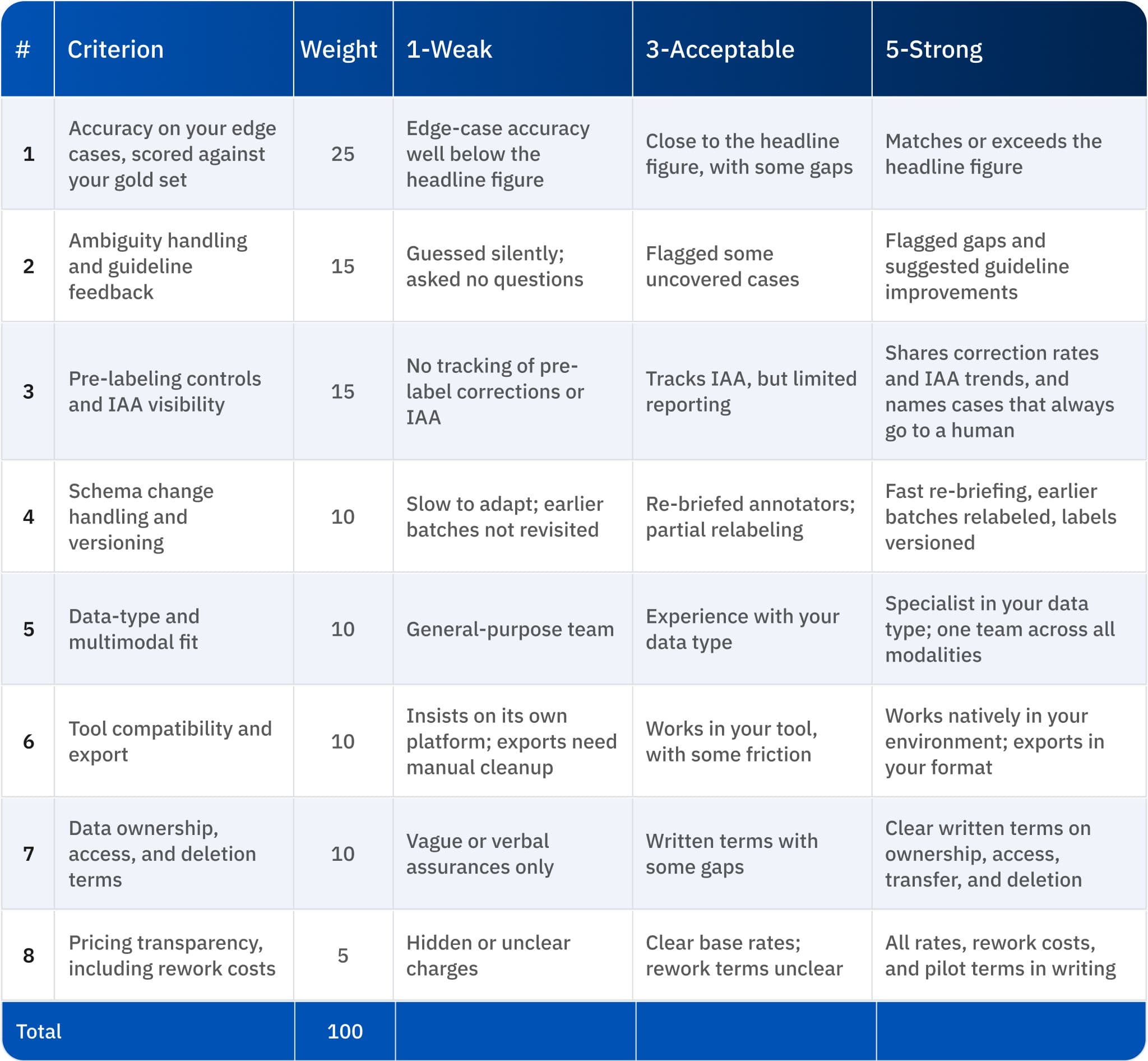
Example: a provider that scores 4 on criterion 1 earns 4 × 25 ÷ 5 = 20 of its 25 points.
Tip: Change the weights to suit your project, as long as they still add up to 100. For instance, if you need data with high regulatory guardrails labeled, raise the weight of criteria number 7 - Data ownership, access, and deletion terms. Or, if you need medical data labeled, where any deviation from regular patterns carries high significance, raise the weight of criteria number 1 - Accuracy on your edge cases, scored against your gold set.
Run This Evaluation in Three Steps
- Filter. Use the baseline checklist to rule out providers that can’t show a documented QA process, verifiable security, a managed workforce, and relevant experience.
- Test. Run a pilot built around your edge cases. Score the results against your own gold set, change the schema partway through, and pay attention to the questions the vendor asks.
- Score. Rate every shortlisted provider on the scorecard shared above, weighted to your project’s risks, so the decision rests on evidence rather than sales claims.
The provider you choose will shape the data your model learns from. We understand the stakes of this decision, because as a data annotation outsourcing service provider, we sit on the other side of it. This guide to evaluating data labeling partners has been built from our experience, inspired by the questions and doubts we have faced across hundreds of clients over the years, by the crippling decision fatigue we have seen clients face when deciding between our team and another vendor, and from the quality we have continuously delivered across diverse data labeling projects.
If a provider welcomes this level of scrutiny, that’s a good sign. If it pushes back, that tells you something too.