
Text Annotation Services
Reduce Label Drift and Improve Model Reliability—Outsource Text Annotation for Complex NLP & LLM Models
- AI-assisted text data pre-labeling with domain-expert review
- Text data annotation compliant with HIPAA, GDPR, ISO, and SOC 2
- IAA monitoring and multi-level QA across every production batch
- Text annotation services for LLM fine-tuning, RLHF, and multilingual NER








Prevent Misinterpreted Text Labels from Weakening Model Performance
Why would you outsource text annotation services when you can crowdsource, use AI labeling platforms, and just get the rest fixed by your in-house tech teams?
If this is your dilemma too, consider that:
- Crowdsourcing yields noisy data; it is simply unreliable for serious AI and tech teams
- Fully automated AI labeling introduces hidden hallucinations and vulnerabilities
- Tasking your core tech team to fix the mess keeps them from building proprietary architecture and revenue-generating features
What any team trying to build Natural Language Processing (NLP) and Large Language Model (LLM) applications needs is accurate training data, with zero guesswork, an audit trail, and domain context baked in, available when they need it. That is what our text annotation company offers.

AI-assisted pre-labeling for faster outcomes with domain specialists to validate AI-generated labels and resolve edge cases.

Continuous multi-annotator consensus and real-time disagreement monitoring to ensure zero label drift across large datasets.

Direct compatibility with your team's preferred labeling platforms, endpoints, and export formats for zero pipeline friction.
Train Models to Interpret True Context with Our Text Annotation Services
Engineered around your specific model architecture, domain taxonomy, and operational goals, our text annotation company produces high-integrity training data needed for reliable Natural Language Processing (NLP) and Large Language Model (LLM) applications. Our annotators follow documented labeling guidelines; complex records undergo expert review; and Inter-Annotator Agreement (IAA) is monitored for subjective or ambiguous cases to ensure consistency across the training dataset.

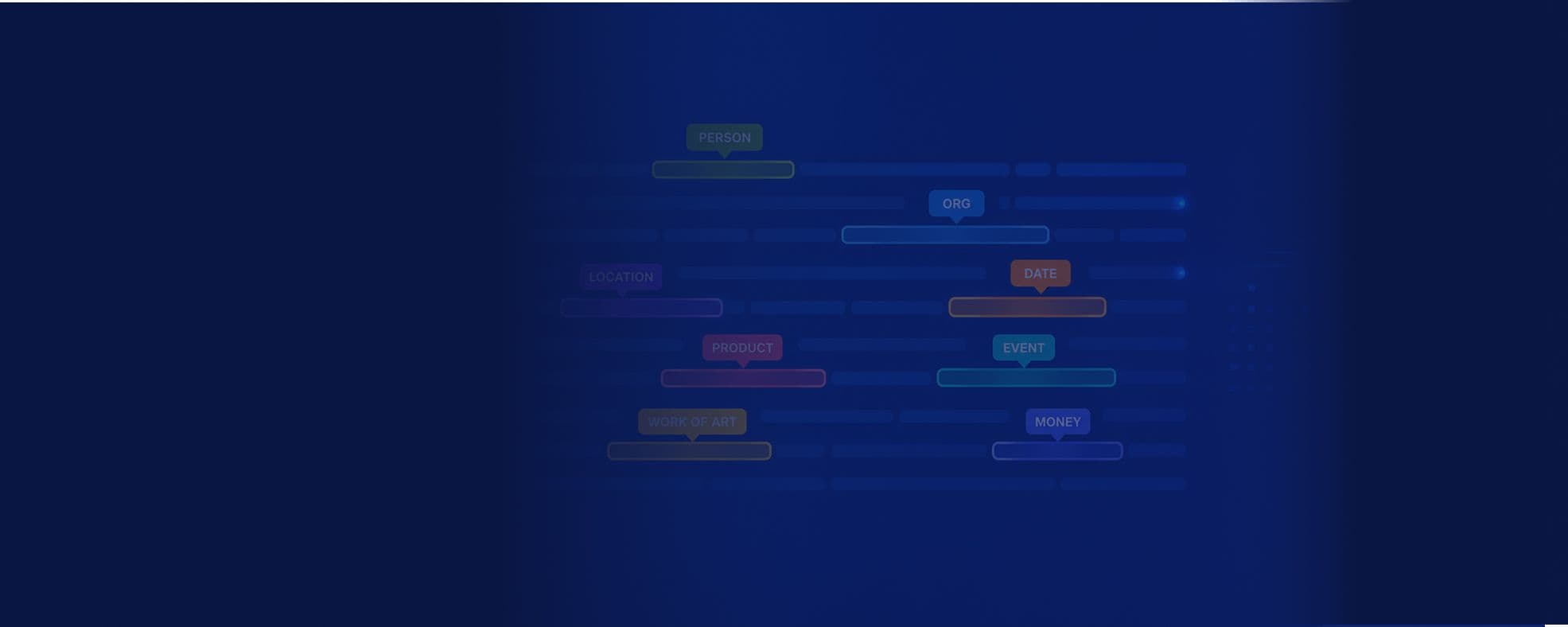
Named Entity Recognition and Entity Linking
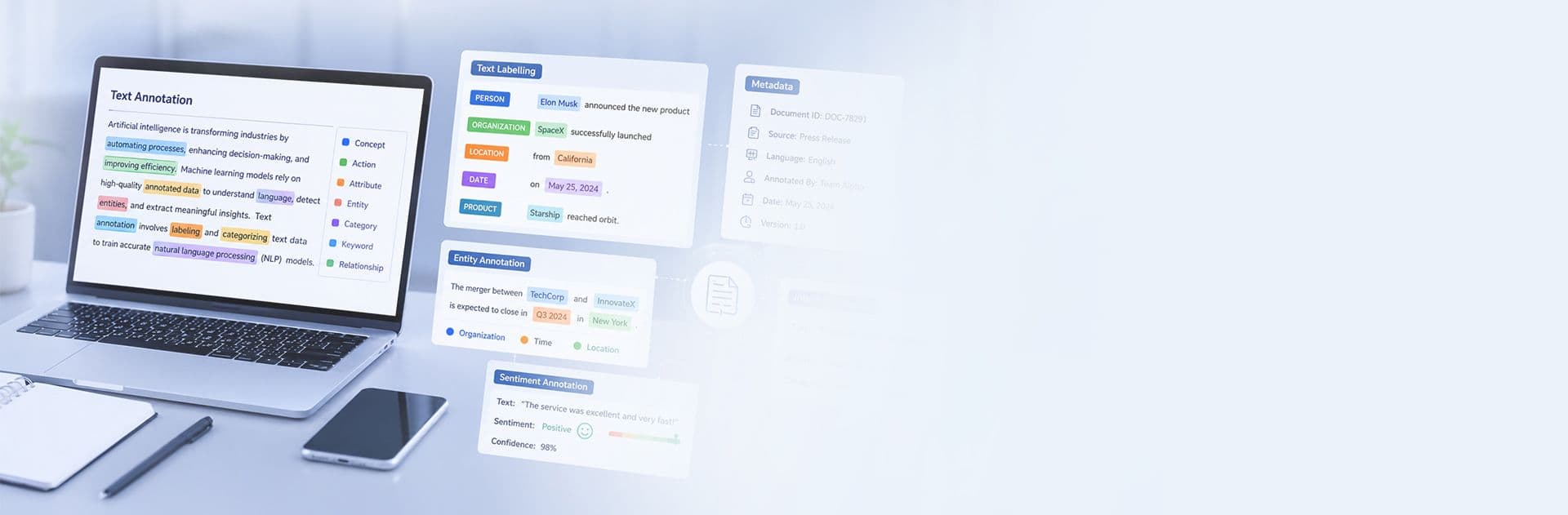
We identify standard and domain-specific entities, including nested and overlapping mentions, using clear boundary and type rules. Where needed, each entity is linked to a verified ID, ontology entry, and database record to support search, retrieval, and knowledge graphs.

Sentiment and Emotion Tagging
We label sentiment at the document, sentence, phrase, entity, or aspect level using classes such as positive, negative, neutral, mixed, or custom to capture accurate user sentiment, which is useful for monitoring brand reputation or measuring customer satisfaction.

Text Classification and Intent Analysis
We label user intent, entities, slot values, dialogue acts, and context shifts across single- or multi-turn text conversations. The resulting training datasets help chatbots, virtual assistants, and support systems understand requests and prioritize actions.

Part-of-Speech Tagging
Each token is labeled according to its grammatical function, such as noun, verb, adjective, pronoun, or preposition, and grammatical links such as subject, object, dependency, and modification to help models interpret language better.
Linguistic and Semantic Annotation
Our annotators link phrases to specific concepts or meanings (such as distinguishing whether "bank" refers to a financial institution or a riverbank based on the surrounding context) and tag grammar, terminology, dialect, and cultural context.

Metadata Tagging for Labeled Text
We add metadata such as document type, source, author, language, date, audience, topic, category, theme, and keywords to improve the organization, filtering, search, and retrieval-augmented generation of training data.
Opinion and Stance Annotation
We identify the opinion holder, target, viewpoint, and supporting or opposing stance. Annotators evaluate context, implied meaning, sarcasm, and mixed positions so models can interpret reviews, surveys, public commentary, debates, and social conversations more accurately.

Semantic Role and Relation Annotation
We label semantic roles such as agent, affected entity, location, and instrument, then capture causal, temporal, part-to-whole, organizational, medical, legal, or custom relationships. Domain specialists review cases where meaning depends on technical context.

LLM Data and RLHF Annotation
We label instruction-response pairs and supervised fine-tuning data, then rank model outputs for relevance, factual accuracy, safety, clarity, helpfulness, and instruction adherence. Preference pairs and scored responses support reward-model training, RLHF, and alignment.
Named Entity Recognition and Entity Linking
We identify standard and domain-specific entities, including nested and overlapping mentions, using clear boundary and type rules. Where needed, each entity is linked to a verified ID, ontology entry, and database record to support search, retrieval, and knowledge graphs.
Part-of-Speech Tagging
Each token is labeled according to its grammatical function, such as noun, verb, adjective, pronoun, or preposition, and grammatical links such as subject, object, dependency, and modification to help models interpret language better.
Opinion and Stance Annotation
We identify the opinion holder, target, viewpoint, and supporting or opposing stance. Annotators evaluate context, implied meaning, sarcasm, and mixed positions so models can interpret reviews, surveys, public commentary, debates, and social conversations more accurately.
Sentiment and Emotion Tagging
We label sentiment at the document, sentence, phrase, entity, or aspect level using classes such as positive, negative, neutral, mixed, or custom to capture accurate user sentiment, which is useful for monitoring brand reputation or measuring customer satisfaction.
Linguistic and Semantic Annotation
Our annotators link phrases to specific concepts or meanings (such as distinguishing whether "bank" refers to a financial institution or a riverbank based on the surrounding context) and tag grammar, terminology, dialect, and cultural context.
Semantic Role and Relation Annotation
We label semantic roles such as agent, affected entity, location, and instrument, then capture causal, temporal, part-to-whole, organizational, medical, legal, or custom relationships. Domain specialists review cases where meaning depends on technical context.
Text Classification and Intent Analysis
We label user intent, entities, slot values, dialogue acts, and context shifts across single- or multi-turn text conversations. The resulting training datasets help chatbots, virtual assistants, and support systems understand requests and prioritize actions.
Metadata Tagging for Labeled Text
We add metadata such as document type, source, author, language, date, audience, topic, category, theme, and keywords to improve the organization, filtering, search, and retrieval-augmented generation of training data.
LLM Data and RLHF Annotation
We label instruction-response pairs and supervised fine-tuning data, then rank model outputs for relevance, factual accuracy, safety, clarity, helpfulness, and instruction adherence. Preference pairs and scored responses support reward-model training, RLHF, and alignment.
A Controlled Workflow for Scalable Text Annotation Services
Text annotation for a large volume of data (as required by most mid- to large-enterprise initiatives) becomes complicated when taxonomy decisions, edge cases, production labeling, and QA are managed as separate activities. For example, one annotator may label “close my account” as a cancellation request, while another may treat it as a general support query. Without a shared rule, both interpretations can spread across the dataset, seeding doubt into the algorithm and causing hallucinations down the line. To prevent such issues, our text data annotation workflow connects annotators, reviewers, and project leads through a single documented set of guidelines. Ambiguous cases are resolved consistently and documented, quality issues are identified during production, and approved changes remain traceable through final delivery.
- 1
Guideline and Taxonomy Design
We define the entity schema, label taxonomy, span boundaries, edge-case rules, escalation criteria, and inter-annotator agreement thresholds with your team. Ambiguous and boundary cases are documented with positive, negative, and borderline examples. Annotators then complete a calibration exercise so differences in interpretation are resolved before production begins.
- 2
Preprocessing and AI-Assisted Pre-Labeling
The text dataset is checked for duplicate records, formatting faults, inconsistent encoding, and other issues that could affect annotation. We use tools such as Label Studio, Prodigy, Doccano, or Labelbox to generate initial labels for high-frequency, low-ambiguity records. These suggestions reduce repetitive work but are not treated as approved ground truth.
- 3
Expert Annotation and Escalation
Trained annotators review and correct machine-suggested labels and manually annotate records that require contextual judgment. Unclear cases are moved into a review queue and evaluated against the approved guidelines. Domain specialists resolve technical, medical, legal, financial, or linguistic edge cases, and each decision is documented so similar records are handled consistently across later batches.
- 4
Batch-Level Validation
QA reviewers assess completed work across annotators, label categories, and production batches. For tasks involving subjective judgment, IAA is measured to identify inconsistent interpretations. If agreement falls below the accepted threshold, disputed labels are reviewed, guidelines are clarified, and annotators are recalibrated. Any affected records or batches are corrected and checked again before approval.
- 5
Delivery and Versioning
Approved datasets are transferred to your cloud environment or annotation platform in JSON, TXT, CSV, XML, CoNLL, BRAT, or a project-specific format. We maintain a record of label revisions, schema updates, and guideline decisions throughout the engagement. When annotation rules change, the revised guidelines are applied to subsequent batches.
Discover the Impact of Our AI Text Annotation Services on Diverse Enterprise Teams
Our NLP annotation services have helped several enterprise AI teams turn complex, inconsistent text into dependable training data. Here’s how we have improved label consistency across a broad range of sector-specific NLP and LLM use cases through clear taxonomies, domain-trained text-annotation teams, and multi-level review.
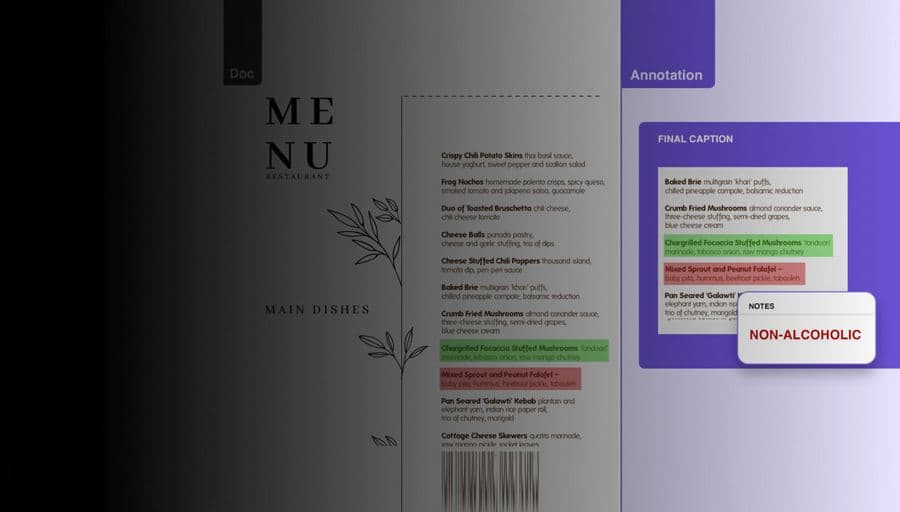
50,000+ Menu Items Classified for a National Restaurant Chain
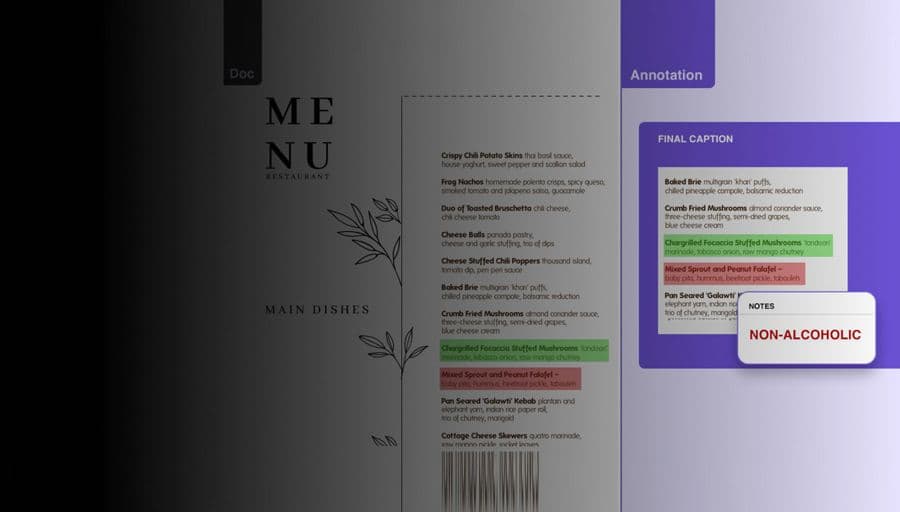
A US restaurant chain with 250+ outlets and two decades of casual dining needed its frequently updated menus annotated. With 50,000+ items across 250+ menus and ambiguous names blurring alcoholic from non-alcoholic, accurate item classification was vital for legal compliance.
How we achieved 100% accuracy classifying 50,000+ menu items for compliance

2,500+ Multilingual Videos and Scripts Labeled Monthly
An entertainment content analytics leader used ML to predict how viewers react to trailers, shows, and films. Labeling 80+ assets daily across English, Spanish, and German while preserving tone and nuance across genres like horror and sci-fi demanded specialized annotation expertise.
How we lifted labeling accuracy to 98–99% and boosted capacity 65%

3,000+ Vehicle Images Annotated for an Insurance Provider
A leading UK auto insurer covering cars, vans, and motorcycles needed vehicle damage annotated across 3,000+ claim images to train its detection model. Telling real dents from reflections and shadows, plus spotting fine scratches in low-light photos, made consistent labeling hard.
How we improved damage detection accuracy 40% and sped up claims 30%

55+ Hours of Drone Video Annotated for Aerial Surveillance Model
A US aerial surveillance technology firm serving agriculture, construction, and real estate needed 55 hours of drone footage labeled to train object detection models. Varying thermal signatures, low-light night scenes, and unpredictable drone movement made automated tracking unreliable.
How we boosted object detection accuracy 30% and operational efficiency 20%
Handling Ambiguous Text and Edge Cases at Scale via Supervised NLP Annotation Services
Automated pre-labeling speeds up routine text annotation but can miss entity boundaries, nested mentions, implied sentiment, similar intents, and domain-specific meaning, simply because AI struggles with context and unpredictable inputs. That is why our human-in-the-loop text labeling services treat AI labels as drafts. We always verify prelabeled data, while senior reviewers and domain specialists resolve records requiring linguistic or contextual judgment. This improves throughput without allowing semantic errors to enter the training dataset.
AI-Generated First-Pass Label Validation
AI models generate preliminary labels for entities, sentiment, intent, classification, and relations. Annotators verify span boundaries, class selection, contextual meaning, and the presence of missing annotations before approval. Incorrect label suggestions are corrected before they enter production batches.
Conflict Detection across Labels and Relationships
Text datasets can contain overlapping entities, contradictory classes, missing relations, incompatible metadata, or labels that violate the approved taxonomy. We identify these conflicts during production and route affected records for review before inconsistent interpretations are introduced into the final dataset.
Edge-Case Routing for Ambiguous Language
Records containing sarcasm, implied intent, nested entities, domain-specific terminology, mixed sentiment, or several valid interpretations are separated from the routine annotation workflow. Senior reviewers handle such exceptions and document the decisions for similar records.
Active Learning and Model Feedback Support
If you already have a model in production or testing, we employ an active learning loop that allows your model to process the high-confidence text it already gets right, while rerouting only low-confidence predictions, rare edge cases, and recurring errors to human annotators, thereby reducing costs while ensuring targeted model improvement.
Preference Adjudication for RLHF
For RLHF projects, our evaluators compare model responses against an approved rubric that covers relevance, factual accuracy, safety, helpfulness, and adherence to instructions. Closely ranked or disputed responses move to senior reviewers for resolution, preventing inconsistent preferences from weakening reward-model training.
Inter-Annotator Agreement and Taxonomy Refinement
For complex datasets, we monitor agreement among annotators, label classes, and production batches. Rising disagreement may reveal unclear intent boundaries, overlapping taxonomies, or inconsistent domain interpretation. Our QA leads update your guidelines, clarify ambiguous definitions, and retrain the team.
Security & Compliance

ISO Certified

HIPAA Compliance

GDPR Adherence

Regular Security Audits

Encrypted Data Transmission

Secure Cloud Storage
Platform-Agnostic Text Annotation Without the Need for Tool Migration
Text annotation platforms differ in how they handle span boundaries, schemas, review queues, collaboration, and export formats. Our teams work with widely used text data annotation tools and can also operate within proprietary client platforms. We select or adapt to the annotation environment around your labeling task, taxonomy, QA process, and delivery format. If your existing platform already supports the required workflow, we work within it rather than requiring a tool migration.










Text Labeling Services Aligned with Your Industry’s Terminology and Use Cases
The same word or phrase can carry different meanings across industries. For instance, a “positive” clinical result does not indicate positive sentiment, while a “claim” may refer to an insurance event, a legal assertion, or a customer request. Our text annotation services for AI applications use sector-specific taxonomies, examples, and escalation rules so labels reflect the terminology, relationships, and operational context of each dataset.

Autonomous Vehicles and ADAS
We annotate vehicle manuals, maintenance records, and driver-assistance conversations for entities, intent, actions, components, faults, and repair outcomes. Related voice commands are linked so in-vehicle assistants can follow context across multi-turn interactions and respond more accurately.

Agriculture and Environment
We annotate research papers, field reports, soil records, crop assessments, and environmental documents for crops, pests, diseases, chemicals, and land use. We also support key-value extraction and classification for permits, soil reports, and formal environmental impact assessments.

Robotics and Industrial Automation
We label technical manuals, task instructions, safety records, error logs, and human-robot transcripts for agents, actions, objects, failures, and corrective steps. These datasets support instruction understanding, safety analysis, robotic path review, and predictive maintenance workflows.
IT and SaaS
We annotate software documentation, bug reports, user feedback, prompt-response pairs, and AI outputs. Work can include SFT data, preference ranking, safety evaluation, multilingual explanations, and intent or entity labels for coding assistants, voicebots, and enterprise AI products.

Aviation
We annotate pilot and ATC transcripts, technical logs, safety reports, and FOD records for flight events, part numbers, failures, repairs, and safety categories. Related reports can be summarized, while pilot voice logs may be aligned with telemetry for operational and behavioral analysis.

eCommerce
We annotate product descriptions, listings, search queries, and reviews for attributes, entities, topics, intent, and aspect-level sentiment. These labels support catalog organization, product search, attribute extraction, recommendations, and analysis of specific praise or complaints.

Retail
We label customer messages, support tickets, inventory records, and marketing copy for intent, products, operational issues, compliance, and brand voice. We also support multi-label tagging, OCR correction, and key-value extraction for scanned or handwritten stock and merchandising records.

Infrastructure Maintenance
We annotate facility reports, permits, inspections, alerts, and safety logs for assets, defects, dates, locations, compliance terms, and corrective actions. OCR correction and key-value extraction support asset review, compliance tracking, maintenance planning, and service prioritization.

Energy, Oil, and Gas
We label inspection logs, survey reports, environmental assessments, maintenance records, and incident reports for equipment, anomalies, causes, events, and compliance terms. We also annotate causal and temporal links and create ontologies for sector assets, failures, and operating conditions.

Banking and Finance
We annotate invoices, tax forms, KYC documents, transactions, complaints, earnings transcripts, and regulatory content for entities, sentiment, intent, anomalies, and compliance terms. These datasets support document processing, fraud and phishing detection, risk analysis, and financial NLP systems.

Geospatial
We annotate addresses, location reports, points of interest, infrastructure descriptions, social posts, and alerts for geographic entities, events, damage, and urgency. These labels support mapping, disaster response, location search, infrastructure analysis, and emergency classification.

Customer Service and Support
We label tickets, chats, emails, and chatbot conversations for intent, urgency, sentiment, entities, escalation, and resolution outcomes. We also extract dates, order numbers, products, and account details and evaluate chatbot responses for relevance, fluency, accuracy, and unsupported claims.

Content Generation
We annotate metadata and AI-generated text or graphics through tagging, red-teaming, preference ranking, feedback labeling, and source verification. These workflows help detect hallucinations and brand-safety risks, fine-tune generation models, and evaluate consistency, relevance, and quality.

Legal
We annotate contracts, rulings, case law, policies, and regulations for clauses, parties, obligations, dates, precedents, defined terms, and legal relationships. Domain-specific guidelines ensure that each concept is labeled according to its contractual or regulatory meaning.

Healthcare
We annotate medical journals, clinical notes, EHR data, patient messages, and research documents for symptoms, procedures, medications, anatomy, and clinical relationships. Sensitive datasets are handled with restricted access and HIPAA-aligned workflows where required by the project.
Get AI Training Data Preparation Support across Multiple Data Modalities
Train models that truly understand context, vision, audio, and language with a single vendor managing all your training data needs. Data-Entry-India provides end-to-end support for all data types, pairing our robust multi-level QA and enterprise security with specialized image, video, audio, and text labeling services.

Get High-Quality Training Data for NLP, LLM, and AI Models
Whether you need text data annotation from scratch or exception routing and management for a high-throughput active-learning feedback loop, our text annotation company offers calibrated human-in-the-loop support tailored to your model's architecture. Send a sample batch to info@data-entry-india.com for a free text annotation sample, and evaluate our accuracy, consistency, and domain expertise before scaling production.