
Scaling Multilingual
ePub3 Content Conversion with WCAG 2.1 AA Compliance


A European Publishing Solutions and Support Provider
The client is a publishing solutions company with more than 35 years of experience in typesetting and editorial production. It supports publishers across an expanding European market. As digital publishing became a larger part of its operations, the company increased its focus on digital accessibility and alignment with the European Accessibility Act. This shift enabled it to serve readers using different formats, devices, and assistive technologies.

Enabling Accessible ePub3
Publishing across Europe
The client wanted digital accessibility built into its ePub3 production process. Its educational, informational, and entertainment titles needed to satisfy WCAG 2.1 AA compliance and European Accessibility Act requirements. The production files also had to remain readable, navigable, and adaptable across widely used devices and assistive technologies. Meeting this brief required an eBook development service partner with specialized accessible-publishing expertise.
Establishing a best-practice framework for revenue cycle processes across all the client's facilities
Streamlining various steps in the healthcare revenue cycle, such as pre-authorization and patient eligibility verification, medical coding & charge capturing, and insurance claims processing
Creating a robust denial management protocol to enable quick resolution of denied claims across multiple payers
Improving cash flow through RCM
Managing Structural Complexity in High-Volume Accessible ePub3 Conversion
Scaling digital accessibility across the client’s catalog exposed three production constraints. Source files lacked machine-readable structure, conversion decisions varied by title, and completed files required technical and functional validation. Unless addressed together, these issues would limit throughput and place delivery schedules at risk.
Limited Semantic Markup in Legacy Assets
Many legacy assets communicated structure visually but carried few dependable semantic cues. Automated parsing could extract content, apply preliminary tags, and normalize common formats. However, it could not reliably determine reading order, heading relationships, or suitable alternative text. Tables, multimedia, and equations introduced further interpretation needs. These elements required manual digital content remediation and semantic HTML5 structuring before accessible ePub3 production could proceed.
Variable Conversion Frameworks
Without a unified template and tagging system, every file introduced a new set of conversion decisions. Repeated manual configuration reduced processing speed and made outputs harder to standardize. The workflow therefore required reusable templates, tag mappings, and content rules that could accommodate different publication types without the need to rebuild conversion logic for every title.
Compliance and Compatibility Validation
Every file had to demonstrate WCAG 2.1 AA compliance and conform to EPUB Accessibility 1.1. It also needed to function reliably with screen readers and text-to-speech software. Supporting the European Accessibility Act therefore required layered validation covering technical conformance, navigation, reading sequence, and practical usability across assistive technologies.
An Accessibility-First ePub3 Workflow with Automated and Specialist Validation
We organized ePub3 content conversion as a controlled production pipeline. A dedicated team of 23 programmers handled 25,000–30,000 pages monthly using common development rules and coordinated quality checks. Our workflow ensured each title was delivered within the SLA-based turnaround times.
Applied Accessibility Standards across the Workflow
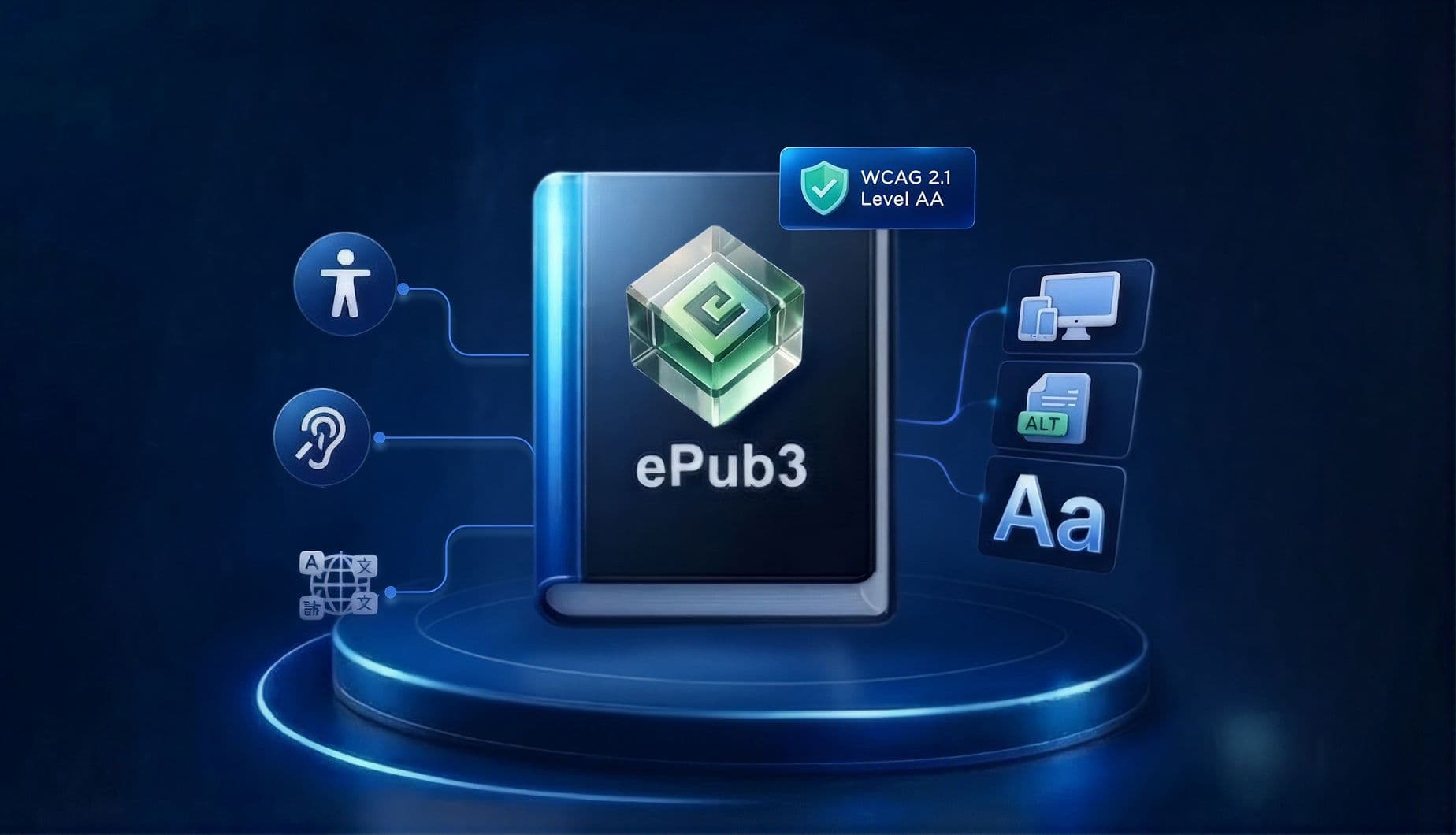
We incorporated accessibility requirements during development and at final delivery. Every title followed WCAG 2.1 Level AA and EPUB Accessibility 1.1 throughout coding and packaging. This supported European Accessibility Act requirements and established consistent access across the client’s approved reading environments.
Restored Logical Content Structure
During semantic HTML5 conversion, we rebuilt headings, paragraphs, lists, and tables as meaningful structural elements. We also corrected hierarchy and reading order so screen readers could interpret relationships between sections. Readers could then navigate by heading, section, or content element instead of moving through the publication line by line.
Added Alt Text and Accessible Navigation
Images, charts, and multimedia received descriptive alt text that communicated information beyond their visual presentation. We added navigation landmarks and ARIA roles for regions such as headers, main content, and footers. Media overlays synchronized visible text with audio narration to support combined visual and auditory reading for multimedia files.
Supported Multilingual and Adaptive Reading
Multi-language ePub3 files let readers switch between language versions without interrupting navigation. Dynamic font resizing, reflowable layouts, and high-contrast modes supported different visual and screen-size requirements. Text adapted to the available display width, reducing horizontal scrolling across reading devices.
Ensured Cross-Device Compatibility
Optimized and tested each title across Kindle, Kobo, Apple Books, mobile reading applications, and desktop browsers. Our compatibility checks also covered NVDA, VoiceOver, and JAWS tools. These tests verified that structure, navigation, and accessibility features remained available across supported devices and assistive technologies.
Combined Automated Checks with Expert Review
We used Ace by DAISY to identify accessibility conformance issues, and EPUBCheck to examine package structure and technical validity of each ePub3 file. Accessibility specialists then manually reviewed every flagged item. They checked both functional usability and standards conformance before approving each file for delivery.
Project Outcomes
Processed 25K–30K Pages Every Month
We completed 25,000–30,000 pages of ePub3 content conversion each month. It helped the client increase monthly production capacity by 65%.
Ensured 100% Standards Conformance
Every delivered ePub3 file met WCAG 2.1 AA and EPUB Accessibility 1.1 requirements, achieving 100% conformance across the complete output.
Reduced Delivery Time by 40%
We completed titles within 4–5 working days. Compared with the client’s previous process, the new workflow reduced average delivery time by 40%.



Prepare Your ePub3 Catalog for Global Accessibility Compliance
Convert legacy publications into files that meet WCAG 2.1 AA and EPUB Accessibility 1.1 requirements. Choose Data Entry India for ePub3 conversion services with accessibility (AA) compliance, supported by semantic HTML5 structuring and specialist validation.