 +1 585 283 0055
 +44 203 514 2601
 +919311468458


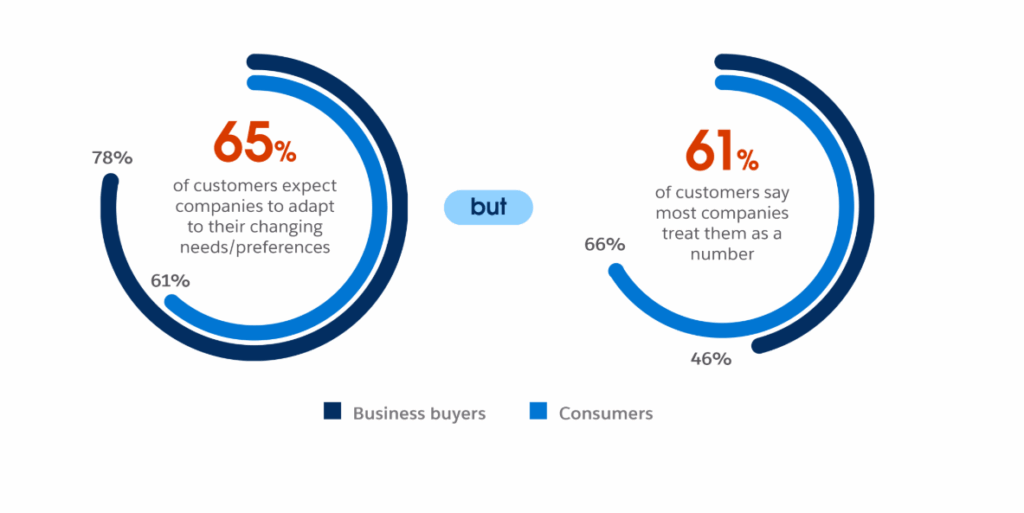
Personalization has become a business-critical component as 81% of customers prefer companies offering a personalized experience.
The core challenge: fragmented customer information prevents effective personalization, such as:
- Basic transaction records are lacking behavioral and demographic context
- Geographic and social media insights remain disconnected from core customer databases
- Renewal patterns and service preferences are based on assumptions rather than verified data
- Manual data management processes cannot scale with growing personalization demands
The solution? Outsourcing Data enrichment services.
Data enrichment systematically integrates external data sources with existing customer profiles to create comprehensive and actionable customer intelligence, allowing businesses to deliver contextually relevant recommendations, precisely targeted marketing, and predictive analysis. While in-house data enrichment requires substantial infrastructure investment, specialized expertise, and ongoing system maintenance that diverts resources from core business functions, outsourcing provides access to advanced enrichment capabilities without the operational complexity.
This guide explores business applications of data enrichment for customer experience personalization and how outsourcing data enrichment services offers vital benefits.
Table of Contents
How Does Data Enrichment Personalize Customer Experience?
1. Personalized Recommendations Based on Behavioral Data
Data enrichment enhances the datasets that power recommendation engines by adding missing information to existing customer profiles and item catalogs. Recommendation engines require both explicit data (ratings, reviews, purchase history) and implicit data (browsing patterns, time spent on pages, click-through behaviors) to function effectively. Data enrichment fills gaps in these datasets by appending demographic information, contact details, social media activity, and cross-platform behavioral data to create comprehensive customer profiles.
The enrichment process directly improves algorithm performance by providing additional data points for recommendation engines:
- Collaborative filtering: Identifies customers with similar preferences and recommends items that similar users like. Enriched demographic and behavioral data help identify more nuanced similarity patterns beyond basic purchase overlap.
- Content-based filtering: Matches customer preferences to item attributes. Enrichment enhances both customer preference indicators and item categorization, enabling more precise attribute matching.
For instance, a recommendation engine with only purchase history might suggest popular items within the same category. With enriched data including social media engagement metrics and demographic information, the system can identify that a customer who purchases business books also engages with productivity content on social media, enabling recommendations for time management tools or professional development courses that wouldn’t be apparent from purchase data alone.
How It Improves Customer Experience: Customers spend less time filtering through irrelevant suggestions because enriched data creates more precise matches between their profiles and available offerings. The enhanced targeting also introduces customers to relevant products they weren’t actively searching for, increasing cross-selling opportunities without overwhelming them with irrelevant suggestions. This leads to higher engagement, conversion rates, and long-term customer relationships.
2. Targeted Marketing Through Customer Segmentation
Customer data enrichment combines first-party customer data with third-party external sources to create comprehensive customer profiles that enable precise market segmentation. 62% of consumers expect personalized messages, highlighting the business imperative for accurate customer segmentation.
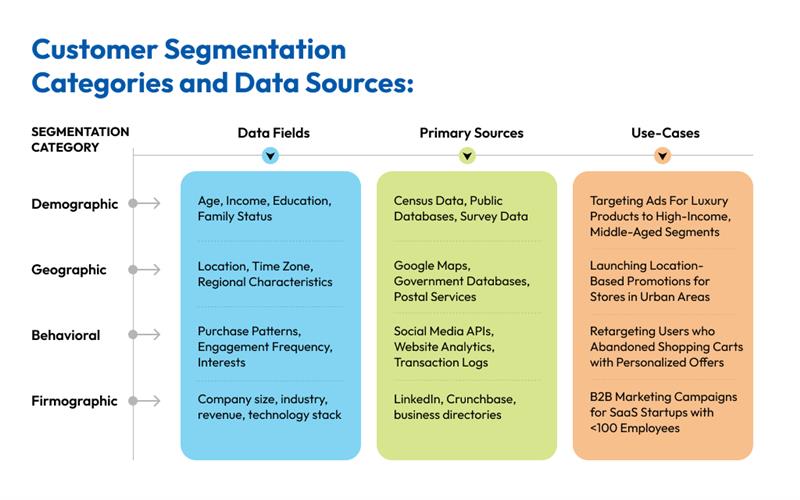
Organizations enhance basic customer records by integrating external data through various enrichment techniques and sources. The customer data enrichment process employs data appending to combine multiple sources, segmentation to divide datasets based on specific criteria, and derived attributes to calculate new insights from existing information. This creates detailed customer profiles that support targeted campaign development across different business models.
- B2B segmentation leverages firmographic data to identify decision-makers’ job titles, company size, industry sector, and technology infrastructure.
- B2C segmentation emphasizes demographic and psychographic data, including individual customer profiles, lifestyle preferences, and geographic location. Both approaches enable customized messaging based on verified profile characteristics rather than broad assumptions.
How It Improves Customer Experience: Customers receive relevant offers and content that match their verified profile characteristics and demonstrated needs. Enhanced segmentation reduces irrelevant outreach by ensuring campaigns align with customers’ purchasing capacity, geographic constraints, and business requirements. This precision eliminates unsuitable suggestions that waste customer time, creating streamlined interactions where customers encounter information directly applicable to their specific situations and decision-making criteria.
3. Location-Based Personalization for Local Relevance
Businesses leverage real-time geographic data combined with enriched customer profiles to deliver tailored digital experiences. This approach uses IP addresses, GPS coordinates, Wi-Fi signals, or proximity beacons to determine user location, then applies GeoEnrichment to enhance basic coordinates with demographic information about local populations, regional purchasing patterns, climate data, cultural preferences, and economic indicators specific to each geographic area.
Companies integrate weather APIs, local event databases, and area-specific purchasing behavior patterns to transform simple location data into comprehensive geographic intelligence that correlates user positioning with local market conditions, seasonal variations, and regional preferences.
GeoEnrichment enables businesses to customize offerings based on verified local conditions and regional characteristics:
- Retailers: Display inventory available at nearby locations with accurate pickup times and store hours.
- Service businesses: Adjust pricing based on local market rates and economic conditions.
- Content platforms: Surface locally relevant information, events, and regional news.
- E-commerce sites: Recommend products appropriate for local climate conditions and seasonal requirements.
How It Improves Customer Experience: Customers receive recommendations that align with their immediate geographic context rather than broad marketing campaigns. GeoEnrichment eliminates irrelevant suggestions—such as winter clothing promotions in tropical climates or store directions for locations hundreds of miles away. Customers encounter inventory information for nearby locations, region-appropriate pricing, and locally relevant promotional offers that match their geographic location and logistical requirements.
4. Preventing Service Disruptions Through Purchase Frequency Analysis
Consider a SaaS company providing project management software to various industries. Data enrichment enhances basic customer transaction histories by appending external information from industry trend reports, financial databases, and organizational data aggregators. The enrichment process incorporates renewal benchmarks and seasonal patterns as weighted variables in predictive models that score renewal risk and trigger automated notifications. Industry-specific renewal patterns vary significantly:
- Manufacturing companies: Prefer 3-year contracts aligned with capital expenditure cycles.
- Startups: Choose annual renewals due to cash flow constraints and rapid scaling needs.
- Educational institutions: Align renewals with academic year budgets.
- Retail companies: Match renewals to fiscal quarter planning.
Mismatched renewal timing can create budget conflicts or force customers into suboptimal contract lengths that don’t match their operational planning.
The predictive model integrates multiple growth indicators to anticipate upgrade requirements before capacity limits cause performance issues. These include employee count increases from HR databases, revenue growth from financial reports, and expanding product usage metrics from platform analytics. For manufacturing clients, the system tracks production cycle data to time renewals during maintenance periods rather than peak operational phases.
How It Improves Customer Experience: Customers receive renewal notifications aligned with their business planning cycles, eliminating the administrative burden of tracking contract deadlines while providing adequate time for budget approval and service evaluation. This timing prevents emergency renewals at higher costs and avoids service interruptions that could disrupt operations. Clients also receive upgrade recommendations based on their actual growth patterns rather than generic upselling, ensuring they maintain optimal service levels without overpaying for unused capacity.
5. Social Media Data Integration for Personalized Customer Interactions
Social media data integration enables businesses to incorporate customer behavioral signals from social platforms into their personalization strategies across multiple touchpoints. Data enrichment enhances existing customer profiles by incorporating social media activity patterns, professional interests, and engagement preferences to create a more comprehensive customer understanding. This approach allows organizations to deliver contextually relevant experiences that reflect customers’ demonstrated interests and social behaviors.
Social media integration in Customer Relationship Management (CRM) systems involves the strategic incorporation of social media data into CRM processes to create comprehensive customer profiles that enable personalized experiences. The enrichment process incorporates social media signals into existing CRM customer profiles, providing context for personalized interactions:
- LinkedIn insights: Professional connections, industry engagement, job changes, and company updates
- Twitter activity: Thought leadership content, real-time interests, and industry discussion participation
- Industry platforms: Purchasing research behaviors, vendor evaluation patterns, and professional milestone announcements
- Network influence: Professional authority indicators and peer interaction patterns
Enhanced CRM profiles enable businesses to improve customer experience as data enrichment delivers personalized outreach and support interactions based on customers’ demonstrated social media activities:
- Sales personalization: Reference prospects’ recent industry contributions or professional milestones during conversations.
- Customer success proactivity: Address concerns raised in social channels before they escalate.
- Real-time engagement: Immediate responses to customer inquiries across social platforms.
- Content relevance: Share industry insights aligned with customers’ demonstrated interests.
How It Improves Customer Experience: Customers receive contextually relevant communications that acknowledge their professional interests and current business challenges rather than generic outreach. They benefit from faster response times to social media inquiries and personalized support that reflects their communication preferences and professional context, creating smoother interactions across all touchpoints while maintaining appropriate business relationship boundaries.
How Outsourcing Data Enrichment Enhances Personalization Efforts
- Access to Specialized Data Enrichment Expertise: Outsourcing partners provide dedicated specialists with niche expertise across diverse industries and data types.
- Structured Workflow Management and Process Optimization: External providers implement established workflows with standardized processes and validation procedures, ensuring consistent output quality.
- Scalability for Dynamic Business Requirements: Organizations can scale enrichment capacity based on seasonal campaigns, market expansion, or product launches without internal resource constraints while maintaining consistent quality standards. Service providers offer on-demand scaling with faster turnaround times, facilitating quicker campaign launches and more responsive personalization strategies that adapt to market changes and customer behavior shifts.
- Resource-Efficient Data Source Management: Outsourcing data enrichment services for better customer insights eliminates the need for internal teams to maintain agreements with external data vendors and API integrations, allowing access to comprehensive data sources without dedicated technical resources. This approach also reduces operational costs related to infrastructure, personnel, and data acquisition, providing better ROI compared to developing in-house enrichment capabilities.
- Comprehensive Regulatory Compliance and Risk Management: Specialized providers adhere to General Data Protection Regulation (GDPR), California Consumer Privacy Act (CCPA), and other industry-specific regulatory protocols. This compliance not only mitigates legal risks but also builds customer trust, which is critical for personalization efforts involving sensitive customer data.
The Human-In-The-Loop Framework: Combining Human Validation with Automated Processing
While choosing data enrichment service providers, organizations should prioritize service providers that implement human-in-the-loop (HITL) approaches, where human specialists validate automated enrichment outputs to ensure data reliability, and automation ensures scalability. This integrated approach enables human specialists to apply contextual knowledge and industry expertise to catch nuanced data scenarios that automated systems might miss, ensuring the enriched data accurately reflects real-world business requirements for effective personalization.