

Image Annotation Services
Deploy Production-Ready CV Models Faster with Dedicated, Domain-Trained Image Labeling Teams
- From standard bounding boxes and classification to complex semantic segmentation and 3D cuboids
- Reviewer-led validation for object boundaries, class accuracy, occlusion, overlap, and edge cases
- In-house teams trained in specialized domains like AV annotation, satellite/aerial data, agriculture, etc.










Move Past Ad-Hoc Crowdsourcing to Fully Managed Image Labeling Services
Every mislabeled image teaches your model the wrong visual pattern. A loose bounding box, missed object, incorrect class, or poorly drawn mask can quietly reduce detection accuracy long before the issue appears in testing. So if you have set out to outsource image labeling, do not just buy labeling capacity — invest in process integrity.
Data-Entry-India provides managed image annotation services designed for zero-tolerance production environments. By pairing automated pre-labeling with strict human consensus checks, multi-stage reviewer validation, and active edge-case routing, we ensure your model trains exclusively on ground truth.

Dedicated, in-house annotators with domain context, trained on your specific schema.

Documented edge case escalation paths to handle visual ambiguity without delaying delivery.

Advanced automated pre-labeling with specialist verification to prevent label drift.
Image Annotation Services, Aligned to Dataset Geometry & Model Objectives
Computer vision models do not learn much from raw images. They learn from the quality, structure, and precision of the labels applied to those images. However, the definition of structured, high-fidelity training data changes according to the model. For instance, a retail checkout AI needs 2D bounding boxes to identify products on a shelf, whereas an autonomous drone requires 3D cuboids and LiDAR tracking to navigate physical obstacles. Our image labeling services provide the exact annotation techniques your architecture demands, ensuring your datasets match your model’s specific training requirements.

2D & 3D Bounding Box Annotation
We use 2D bounding box annotation for detecting 2D objects and 3D cuboids where depth, orientation, and spatial position are required, such as in AR/VR, robotics, autonomous systems, and spatial AI applications. For complex datasets, we also mark occlusion, truncation, overlap, and partial object visibility so models learn from real-world visual conditions.

Semantic Segmentation
Our image annotation team uses semantic segmentation to map the entire dataset pixel-by-pixel, ensuring your model can accurately distinguish complex boundaries like roads from sidewalks or healthy crops from invasive weeds. We enforce rigorous masking rules and strict class consistency to eliminate the pixel gaps and class bleed at the border.

Instance Segmentation
While semantic segmentation maps general object classes, we use instance segmentation to isolate and track every individual object within that class. By assigning a distinct mask and unique ID to each individual asset, we train your models to successfully count and separate touching, overlapping, or densely clustered objects—such as retail products on crowded shelves, vehicles in tight traffic, or inventory items in warehouse streams.

3D Point Cloud & LiDAR Annotation
To help models calculate depth, distance, and trajectories in three-dimensional environments, we deliver precise 3D cuboid and semantic labeling for spatial LiDAR data. To maintain absolute data consistency across 2D and 3D coordinate planes, we enforce rigid frame-to-frame checks, eliminating ID-switching, drifted trajectories, and spatial continuity errors across complex, moving scenes.

Keypoint/Landmark Annotation
We support standard and custom schemas for keypoint and landmark annotation, including COCO 17-point human pose annotation, 68-point and 98-point facial landmark annotation, hand keypoints, and product landmarks to help models understand pose, alignment, geometry, movement, and feature position.

Polygon Annotation
When rectangular boxes fail to capture irregular boundaries, our annotators trace exact object shapes using high-density polygons. By enforcing strict rules for vertex placement and edge alignment, we ensure your models accurately evaluate complex geometries like road defects, agricultural fields, land parcels, and vehicle damage

Line and Polyline Annotation
For linear features like lanes, curbs, cables, and pipeline routes, our annotators utilize precise polyline tracking to map continuous paths. We enforce rigorous start-end logic, uniform directional alignment, and strict point-order continuity. QA checks focus on broken lines, incorrect point order, missing segments, continuity errors, and directional consistency.

OCR Verification & Correction
We cross-verify automated OCR outputs against original source images, manually correcting skewed text zones, tabular misalignments, and corrupted key-value pairs. By enforcing absolute data integrity for structured forms, KYC workflows, and multilingual datasets, we transform raw, noisy text extractions from images into flawless, structured ground truth for intelligent document processing models.
Image Classification and Metadata Tagging
Our annotators categorize entire images or apply multi-label tags to define scene context, lighting conditions, object properties, and background environments. We enforce strict taxonomy mapping and multi-annotator consensus to eliminate subjective bias, delivering highly structured metadata for content moderation, visual search, and e-commerce recommendation engines.
2D & 3D Bounding Box Annotation
We use 2D bounding box annotation for detecting 2D objects and 3D cuboids where depth, orientation, and spatial position are required, such as in AR/VR, robotics, autonomous systems, and spatial AI applications. For complex datasets, we also mark occlusion, truncation, overlap, and partial object visibility so models learn from real-world visual conditions.
3D Point Cloud & LiDAR Annotation
To help models calculate depth, distance, and trajectories in three-dimensional environments, we deliver precise 3D cuboid and semantic labeling for spatial LiDAR data. To maintain absolute data consistency across 2D and 3D coordinate planes, we enforce rigid frame-to-frame checks, eliminating ID-switching, drifted trajectories, and spatial continuity errors across complex, moving scenes.
Line and Polyline Annotation
For linear features like lanes, curbs, cables, and pipeline routes, our annotators utilize precise polyline tracking to map continuous paths. We enforce rigorous start-end logic, uniform directional alignment, and strict point-order continuity. QA checks focus on broken lines, incorrect point order, missing segments, continuity errors, and directional consistency.
Semantic Segmentation
Our image annotation team uses semantic segmentation to map the entire dataset pixel-by-pixel, ensuring your model can accurately distinguish complex boundaries like roads from sidewalks or healthy crops from invasive weeds. We enforce rigorous masking rules and strict class consistency to eliminate the pixel gaps and class bleed at the border.
Keypoint/Landmark Annotation
We support standard and custom schemas for keypoint and landmark annotation, including COCO 17-point human pose annotation, 68-point and 98-point facial landmark annotation, hand keypoints, and product landmarks to help models understand pose, alignment, geometry, movement, and feature position.
OCR Verification & Correction
We cross-verify automated OCR outputs against original source images, manually correcting skewed text zones, tabular misalignments, and corrupted key-value pairs. By enforcing absolute data integrity for structured forms, KYC workflows, and multilingual datasets, we transform raw, noisy text extractions from images into flawless, structured ground truth for intelligent document processing models.
Instance Segmentation
While semantic segmentation maps general object classes, we use instance segmentation to isolate and track every individual object within that class. By assigning a distinct mask and unique ID to each individual asset, we train your models to successfully count and separate touching, overlapping, or densely clustered objects—such as retail products on crowded shelves, vehicles in tight traffic, or inventory items in warehouse streams.
Polygon Annotation
When rectangular boxes fail to capture irregular boundaries, our annotators trace exact object shapes using high-density polygons. By enforcing strict rules for vertex placement and edge alignment, we ensure your models accurately evaluate complex geometries like road defects, agricultural fields, land parcels, and vehicle damage
Image Classification and Metadata Tagging
Our annotators categorize entire images or apply multi-label tags to define scene context, lighting conditions, object properties, and background environments. We enforce strict taxonomy mapping and multi-annotator consensus to eliminate subjective bias, delivering highly structured metadata for content moderation, visual search, and e-commerce recommendation engines.
Auditable Image Annotation Outsourcing Built for Enterprise Training Data Demands
A reliable image annotation company should be able to explain how labels are created, reviewed, corrected, and delivered. Our workflow is built around that visibility. We define class rules, configure the right annotation environment, calibrate annotators, apply QA checkpoints, and document edge-case decisions so your ML team knows how each batch moves from raw image data to model-ready labels.
- 1
Visual Schema and Annotation Rule Setup
We begin by understanding your model objective, data type, annotation technique, class hierarchy, output format, and acceptance criteria. Our team works with your project stakeholders to define annotation rules, edge-case handling instructions, attribute taxonomies, visibility markers, and examples of correct and incorrect labels. This becomes the reference document for annotators, reviewers, and QA leads throughout the project.
- 2
Tool Setup and AI-Assisted Pre-Annotation
Based on the annotation type and dataset complexity, we configure the right annotation environment, whether that is CVAT, Labelbox, V7, Supervisely, Label Studio, or your proprietary platform. Where suitable, AI-assisted pre-labeling is used to generate first-pass boxes, masks, outlines, or object labels, reducing manual effort on repetitive patterns while keeping final approval under human review.
- 3
Human Review and Label Refinement
Trained annotators review, adjust, and validate AI-generated or manually created labels against the approved schema. Complex cases such as occlusion, overlapping objects, unclear boundaries, low-contrast images, subjective classes, or domain-specific visual patterns are escalated to senior reviewers or subject matter experts. If a case falls outside the existing guidelines, the decision is documented and added to the schema for future batches.
- 4
Quality Assurance and Final Delivery
We hand the clean data back in the format your systems typically consume.
Delivered as CSV, Excel, SQL, a custom database, or direct CRM/ERP upload
Records are mapped to your schema, so they can be ingested without breaking
Transferred over secure VPN or encrypted API connectors
Explore the Real-World Impact of Our Image Annotation Services
See how our image labeling services have supported AI projects across multiple industries.

2,000+ Aerial Images Annotated for Traffic Analysis AI
A US government urban planning agency ran a traffic analysis model built on aerial imagery to manage city congestion. Varying image resolution, inconsistent lighting, and 2,000+ images spanning eight object classes, from cars to cyclists, made precise vehicle labeling demanding.
How we drove a 35% model accuracy gain and better traffic monitoring

98% Accuracy across 3K+ Images for Street Maintenance AI
A municipal department maintaining urban cleanliness and infrastructure needed 3,000+ street images annotated to power its AI maintenance system. Images shot in rain, fog, and low light, plus pedestrians and vehicles obscuring litter, potholes, and amenities, made precise labeling tough.
How we hit 98% annotation accuracy and lifted detection accuracy 45%

5,000+ Solar Panel Images Annotated for Defect Detection
A UK solar panel manufacturer needed 5,000+ drone-captured RGB and thermal images labeled to train its defect detection algorithm. Spotting micro-cracks, delamination, and hotspot heating, while mastering a proprietary tool and reading shading patterns, demanded expert annotation.
How we improved defect detection accuracy by 35% and cut overhead costs by 20%
3,000+ Vehicle Images Annotated for an Insurance Provider
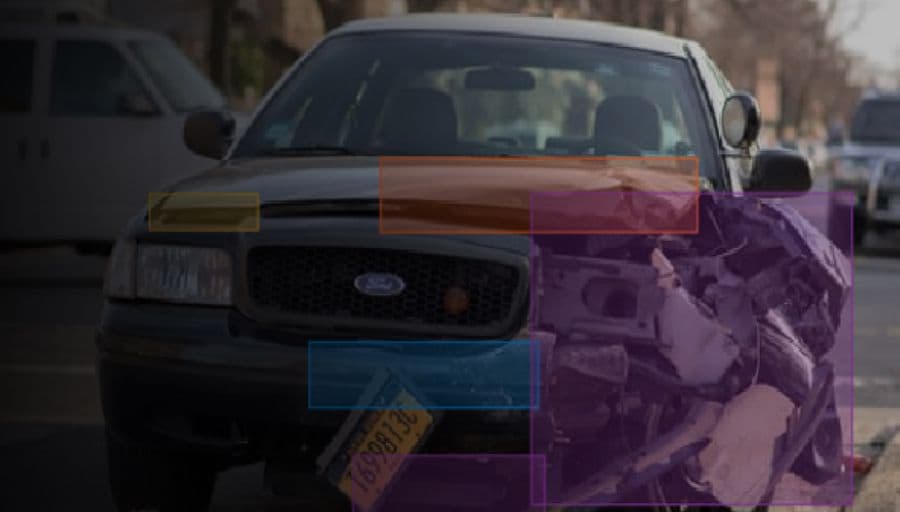
A leading UK auto insurer covering cars, vans, and motorcycles needed vehicle damage annotated across 3,000+ claim images to train its detection model. Telling real dents from reflections and shadows, plus spotting fine scratches in low-light photos, made consistent labeling hard.
How we improved damage detection accuracy 40% and sped up claims 30%
An AI-Augmented Image Annotation Company that Actively Fixes the Failures of Automation
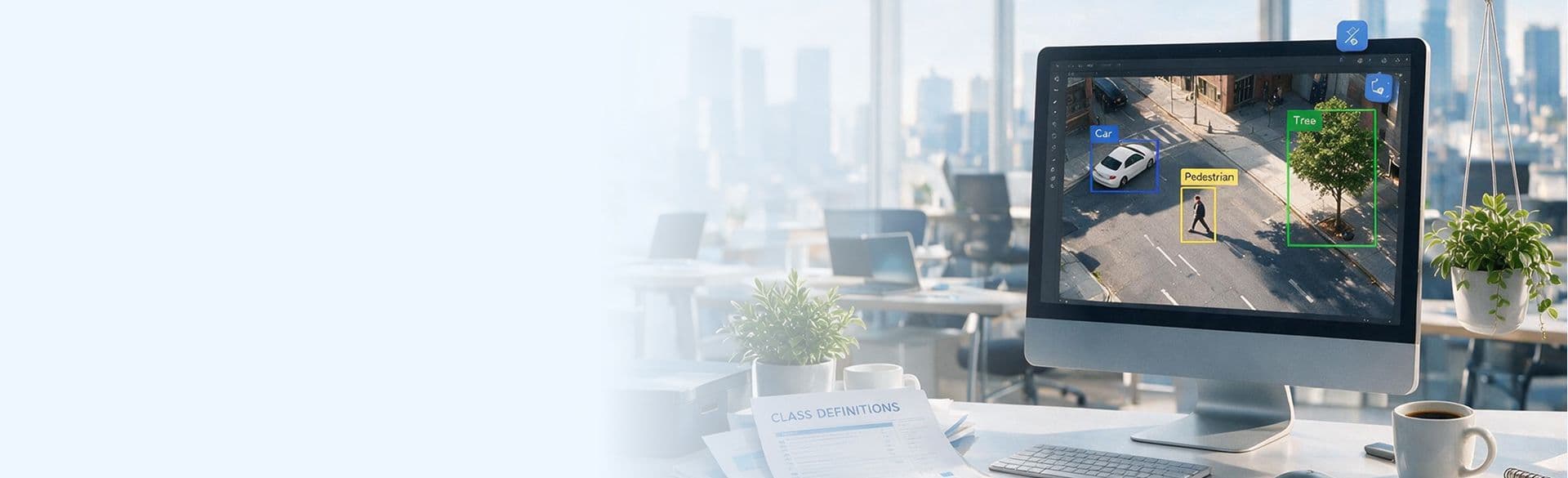
Automated pre-labeling and foundation models dramatically accelerate data ingestion, but they routinely fail at the margins—missing micro-objects, merging dense boundaries, and bleeding masks in low-contrast regions. Left unchecked, these automated errors introduce catastrophic noise into your training architecture. We bridge this gap by deploying specialized human-in-the-loop workflows that treat machine-generated labels merely as raw drafts. Our data specialists actively isolate, intercept, and correct algorithmic drift, ensuring your final delivery behaves as flawless ground truth.
Validating AI-Generated First-Pass Labels
For suitable datasets, object detection and classification models generate initial labels such as bounding boxes, polygon outlines, object classes, and instance-level annotations. Our annotators then refine these labels for tightness, class accuracy, visibility, missing objects, and boundary placement before they enter the final dataset.
AI-Assisted Mask Creation for Segmentation
For segmentation-heavy projects, segment anything models (SAM) style workflows can help generate initial masks from clicks, prompts, or rough object boundaries. These masks are not accepted as-is. Annotators review and correct edges, remove spillover, separate nearby objects, and refine complex silhouettes for semantic and instance segmentation tasks.
Conflict Detection across Classes and Instances
Large visual datasets often contain annotation conflicts that are easy to miss manually. We check for issues such as overlapping masks, merged instances, duplicate object IDs, inconsistent boundary treatment, missing regions, and attribute labels that do not match the image. These conflicts are routed to QA reviewers before delivery.
Edge-Case Routing for Difficult Images
Images with occlusion, low contrast, blur, unusual lighting, dense object clusters, partial visibility, or unclear class boundaries are separated for senior review. This prevents difficult images from being treated like routine annotation work and reduces the risk of weak labels entering the training set.
Active Learning and Model Feedback Support
When your workflow includes active learning, we can prioritize images based on model uncertainty, confidence scores, error clusters, or recurring failure patterns. This helps focus human annotation effort on the examples that are most likely to improve model performance, especially rare classes and visually ambiguous cases.
Inter-Annotator Agreement and Guideline Refinement
We track consistency through inter-annotator agreement checks, sample audits, reviewer scoring, and recurring correction analysis. If disagreement rises, QA leads recalibrate the team, update the annotation guidelines, and document new examples so future batches follow the same labeling logic.
Security & Compliance

ISO Certified

HIPAA Compliance

GDPR Adherence

Regular Security Audits

Encrypted Data Transmission

Secure Cloud Storage
Image Annotation Platforms Our Teams are Proficient in
Rather than forcing you to migrate datasets to a preferred internal tool, our teams deploy directly inside your established environment or your proprietary labeling application. We handle the complete end-to-end workspace configuration, structuring the platform to match your specific ontological hierarchies, attributes, and multi-layered validation checkpoints.






Visual Training Data Prepared for Real-World Model Operation Conditions
Image annotation requirements change sharply from one industry to another. A road scene, a retail shelf, a medical scan, a satellite image, and an invoice image cannot be labeled with the same rules. We build annotation schemas around industry-specific visual patterns, terminology, failure conditions, etc., then assign annotators and reviewers with relevant dataset experience.

IT and SaaS Companies
- 3D point cloud and LiDAR annotation for robotics, AR/VR, and spatial AI products
- Keypoint, landmark, and semantic segmentation support for AI-enabled applications
- Multimodal labeling across image, video, and text datasets for AI agents, LLMs, and product automation
- Visual question-answer pairs, image-text pair annotation, and visual QA labeling for VLM workflows

Agriculture
- Multispectral image labeling for vegetation analysis, soil health, and stress detection
- Image categorization for livestock monitoring and farm asset classification
- Drone and satellite image annotation for crop monitoring, field analysis, and pest detection
- Polygon annotation for field boundaries, crop zones, water bodies, and land parcels

Robotics
- 3D point cloud annotation for robotic navigation and LiDAR segmentation for workspace understanding
- Cuboid annotation for depth perception and object positioning
- Bounding boxes for object detection, localization, and grasping workflows
- Skeletal and keypoint tagging for human-robot interaction analysis
- Human review of robotic navigation paths and movement-related visual data
Autonomous Vehicles and ADAS
- 2D image annotation using bounding boxes and 3D cuboids for vehicles, pedestrians, cyclists, signs, and road objects
- Camera, LiDAR, and radar alignment support for 3D scene perception
- Temporal tracking across sequential frames for navigation, object permanence, and collision avoidance
- Semantic segmentation for drivable areas, lane markings, curbs, traffic signs, and road infrastructure

eCommerce
- Bounding boxes for object detection and visual search modules
- Product image tagging for recommendation engines and catalog intelligence
- Product attribute annotation for color, shape, material, size, style, and variant recognition
- Web scraping for AI training data collection to train product and pricing models

Retail
- Product categorization and multi-label classification for smarter product discovery
- Attribute annotation and hierarchy labeling for product recommendation systems and image-search
- Shelf analytics using bounding boxes, object counts, and placement-level tagging
- Delivery route and field-service image annotation for retail operations intelligence
- CCTV and security camera image labeling for store analytics and loss-prevention models

Energy, Oil, and Gas
- Image categorization for thermal, infrared, and inspection imagery
- Semantic segmentation for infrastructure mapping, land-use monitoring, and environmental assessment
- Bounding boxes for equipment, pipeline assets, anomalies, and facility components
- Keypoint annotation for facility condition monitoring and asset-risk analysis
- Polygon annotation for geological features, extraction zones, and land structures

Aviation
- Polygon and bounding box annotation for CCTV and operational imagery
- Semantic and instance segmentation for FOD detection, runway monitoring, and maintenance workflows
- Audio-to-image syncing, cockpit interaction transcription, and visual flight data mapping for pilot behavior analysis
- Sensor and flight data annotation for route optimization and operational analysis

Infrastructure Maintenance
- Satellite and drone image annotation for asset condition monitoring and inspection workflows
- Thermal and infrared image labeling for leak detection, failure identification, and risk monitoring
- Object detection for infrastructure surveillance, road defects, pipelines, and facility assets
- Semantic segmentation and bounding boxes for mapping, inspection, and damage analysis

Geospatial
- Satellite image segmentation for infrastructure, vegetation, and environmental mapping
- 3D LiDAR point cloud labeling for urban mapping and spatial analytics
- Image categorization to identify healthy/diseased vegetables and land changes over time
- Polygon annotation for geographic features, land parcels, roads, and built structures
- Drone image labeling to assess infrastructure condition

Finance
- Image categorization and spatial tagging of receipts, transaction artifacts, and identity documents
- Visual document segmentation for VQA datasets and intelligent document processing models
- Instance segmentation for watermarks, holograms, signatures, stamps, and verification marks
- Bounding box and key-value pair annotation for invoices, checks, tax forms, IDs, and KYC documents

Customer Service and Support
- Image classification and tagging for customer-submitted photos, claims, complaints, and service requests
- Image segmentation and OCR for support documents such as warranties, receipts, forms, and product images
- Frame-level annotation of screen recordings and how-to visuals for automated support summaries
- Visual sentiment tagging and RLHF for avatar-led support, video feedback, and customer interaction analysis

Content Generation
- Image-to-text auditing to identify hallucinations, incorrect visual claims, and factual inconsistencies in AI-generated graphics
- Content metadata tagging for predictive media tools and visual content intelligence
- Image-based red teaming to detect brand-safety, bias, and policy violations in generated visuals
- Human-in-the-loop image ranking and visual preference labeling for generative model refinement
Annotation Support beyond Image Data
When video, language, or audio enters your training pipeline, the same QA structure, security controls, and annotator teams carry over to the services below - without the overhead of vetting a new vendor.

Get Model-Ready Image Datasets without Annotation Bottlenecks
Looking for an image annotation company that can work within your schema, tools, QA expectations, and delivery format? Share your dataset requirements with us, and we’ll help plan an annotation workflow that matches your model goals, visual complexity, and production timeline.