
eBook Typesetting
Scaling eBook Typesetting and Digital Pre-Press to 30K+ Pages Monthly for a Global Publisher
An International Multi-Genre Publisher
The client is a globally recognized publishing house whose catalog spans academic, STM (Scientific, Technical, and Medical), educational, trade, and illustrated titles. They publish more than 1,000 new releases each year in print and digital editions. They serve institutional buyers and individual consumers across North American, European, and Asia-Pacific markets.

eBook Typesetting Services for Five Genres across Digital and Print Formats
The publisher’s work involved converting raw manuscripts into 25,000 to 30,000 composed pages per month. During peak publishing cycles, production volumes could rise considerably beyond the standard monthly range without corresponding extensions to committed release schedules.
STM manuscripts
packed with equations, chemistry notation, and tabular data that demanded technically fluent composition.
Academic volumes
built on strict citation structures, multi-level footnotes, and formal layout hierarchies.
Educational content
published in multiple languages, each carrying its own typographic rules and script considerations.
Trade titles
where creative page design and reading comfort carried commercial weight.
Illustrated books
in which the balance between artwork and text defined the reading experience.
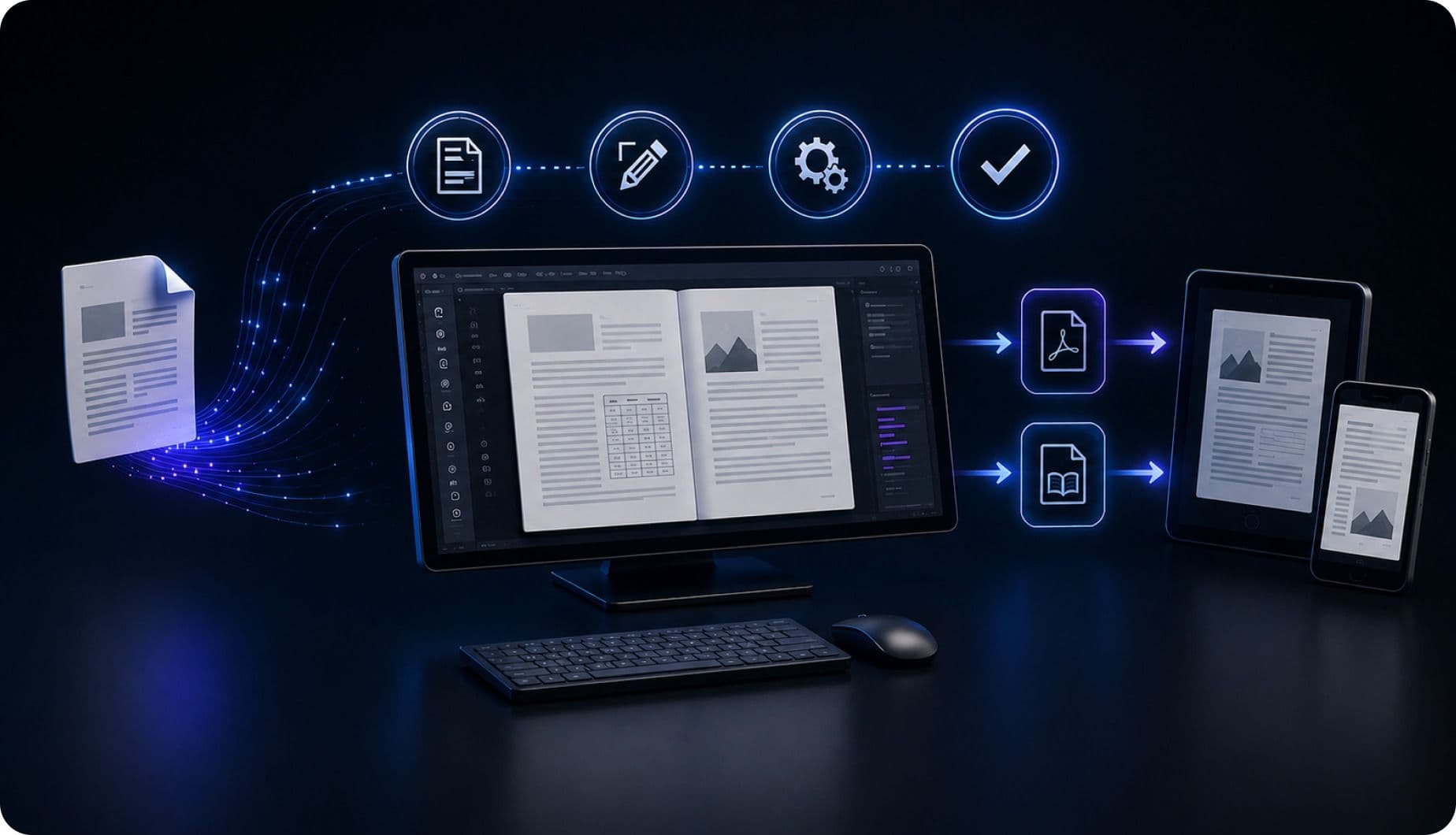
Each applicable title also required two production-ready outputs from the same workflow. Print teams needed PDF/X-compliant files for manufacturing, while digital teams required structured XML and EPUB3 files for electronic distribution. Both outputs had to be usable by the publisher's downstream teams without additional eBook conversion, restructuring, or formatting cleanup.
Every month, print and digital titles were published across five genres:
Each genre followed its own editorial, structural, and typographic conventions. The client needed an eBook typesetting service partner who could maintain accuracy across the five genres while delivering pages at scale.
Print Pagination, Strict Layout Consistency, and Unpredictable Publishing Volumes
Our ePublishing services, particularly eBook typesetting and digital pre-press services, have supported the publisher’s production operations for over ten years, beginning with a small engagement and steadily expanding as catalog volume and structural complexity grew. Here are the major challenges our team faced:
Producing print and digital outputs from the same source added structural complexity. PDF/X production depended on fixed pagination, stable page geometry, and precise object placement. XML and reflowable EPUB required adaptable content structures while keeping both outputs synchronized.
Genre diversity limited the use of standardized templates. Academic and STM publications followed highly structured formatting conventions, while trade and illustrated titles emphasized visual composition and readability. Each required a different approach within the wider workflow.
Many publications contained structures that required compositor judgment. Nested lists, callout boxes, sidebars, cross-references, mathematical equations, intricate tables, and multi-level footnotes frequently required deliberate page-by-page composition rather than template-driven processing.
Related titles had to remain visually consistent over time. Books within the same series or imprint needed consistent headings, margins, typography, spacing, and color treatments, even when different team members produced individual volumes months apart.
Late-stage revisions could destabilize completed layouts. Revised paragraphs, tables, figures, or citations could alter pagination or move surrounding elements. Proof handling therefore required rigorous version control and checks for unintended layout changes.
Publishing volumes were volatile and increased without any deadline extensions. Monthly page counts could exceed 30,000 during seasonal peaks, while committed delivery schedules remained unchanged.
The Core Production Challenge: Producing Print and Digital Outputs from a Single Source
Single-source publishing created an inherent structural conflict. Print composition relied on fixed page dimensions, controlled pagination, and precise relationships between text, figures, and other visual elements.
Digital formats such as EPUB3 worked differently. Reflowable content had to adapt to different screen sizes while maintaining semantic structure, reading order, references, tables, images, and other content relationships.
The publisher's five-genre catalog added another layer of complexity. An STM title containing equations and data-heavy tables required different print-to-digital treatment from an illustrated publication or design-led trade book. These requirements had to be managed within a production operation handling 25K–30K+ pages each month.
Maintaining independent print and digital production tracks was not practical at this scale. It would have led to:
- Doubling the quality analysis efforts
- Introduction of version drift between print and digital outputs
- Delay in output delivery
The eBook typesetting and digital pre-press workflow therefore needed to reconcile both output formats within the same production model.
A Unified Production Pipeline Combining Expert Compositors and Automation
We structured each publishing genre around its own composition requirements while maintaining common controls for file management, QA, versioning, resource allocation, and delivery. This approach allowed print and digital outputs to originate from the same production source, while automation handled repeatable work and human experts handled layouts requiring critical judgment.
TOOLS & TECHNOLOGIES
Adobe InDesign
Primary composition environment for page layout, master pages, structured paragraph and character styles, XML mapping, and print production.
MathType and LaTeX
Used for mathematical equations, formulas, chemical notation, scientific expressions, and other technically complex publishing content.
Adobe Acrobat
Used for PDF/X preflight, print-production validation, proof review, and final output verification.
ExtendScript/JSX
Used for batch processing, repetitive production tasks, series-level formatting audits, and style-consistency checks.
PROJECT OUTCOMES
25,000 to 30,000 Pages Typeset Monthly
We sustained high-volume production across STM, academic, educational, trade, and illustrated publications.
98.8% First-Pass Accuracy Rate
Enabled most titles to clear editorial review during the first proof cycle.
40% Faster Overall Turnaround
We improved turnaround during peak publishing cycles without compromising typographic accuracy.
10+ Years of Partnership
Reflects the client’s faith in consistent delivery as publishing volumes, genre requirements, and production complexity increased.
Scale Your Publishing Operations with an Experienced eBook Typesetting Service Partner
Keep demanding publishing schedules on track without adding pressure to internal teams. Our ePublishing services provide production support for complex titles across print and digital formats, while helping you manage fluctuating volumes with consistent quality.