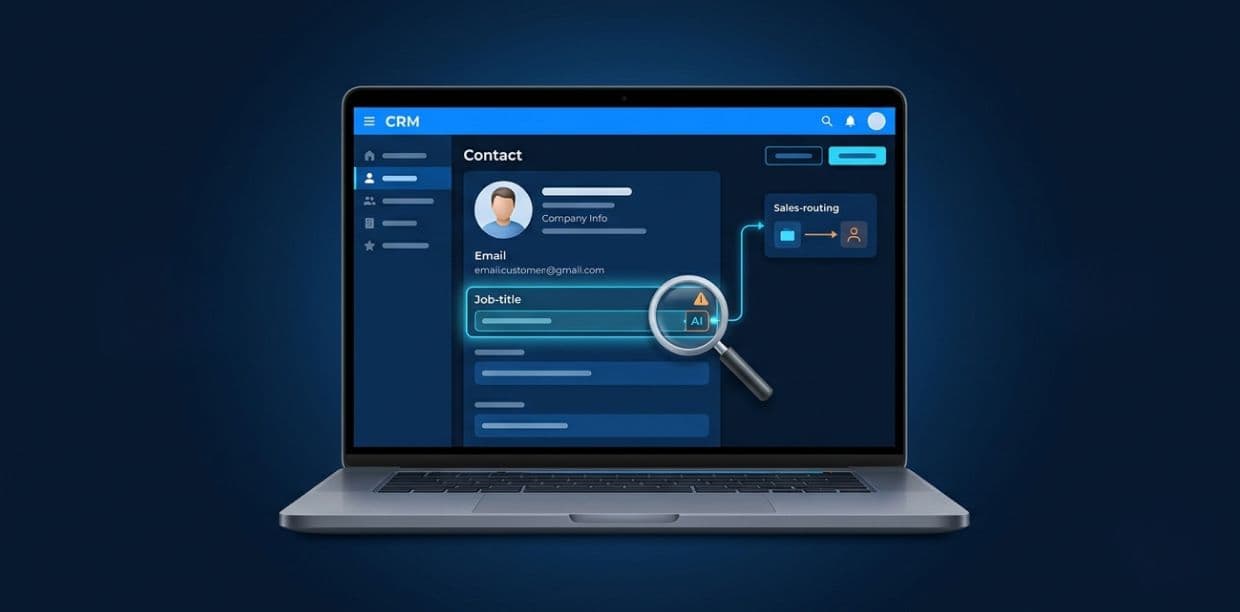
AI (automated data cleansing tools, data enrichment tools, and such) affects CRM data hygiene in two opposite ways.
- Positive: It identifies and corrects problems in existing records, including duplicates, inconsistent formats, and non-standard job titles, much faster than manual data cleansing. This improves CRM data quality.
- Negative: It can populate missing fields with inferred information that has not been verified. These values may pass completeness and formatting checks even when they are factually incorrect.
As a result, a CRM can score higher on data quality metrics without actually becoming more reliable. That gap has become a concerning revenue problem for businesses.
The Growing Risk of Using AI with Unreliable CRM Data
As AI tools increasingly update records and make decisions without human review, unverified information can influence business decisions before anyone identifies the error.
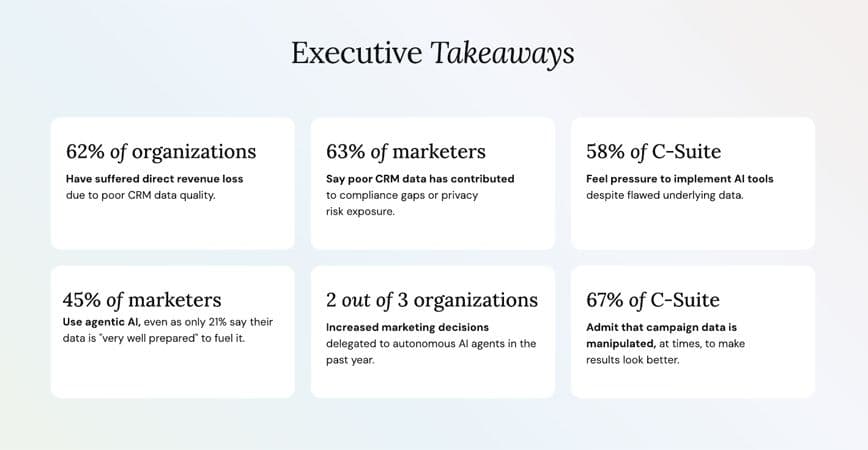
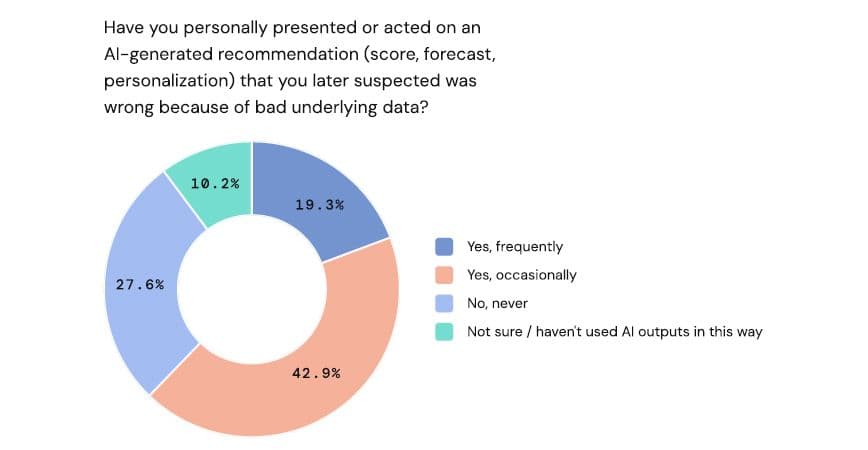
Validity’s 2026 State of CRM Data report, drawing on responses from 500 marketing professionals, reveals a concerning pattern: 78% of C-suite leaders and 92% of senior vice presidents and vice presidents have made decisions based on AI recommendations whose accuracy they subsequently doubted because of unreliable data.
That’s why improving the underlying CRM data is essential before relying on AI-driven decisions. In fact, AI itself can help address many of these data quality issues by identifying errors, standardizing records, and reducing manual correction efforts.
Where AI Improves CRM Data Quality
AI helps sales and marketing teams identify CRM records that need correction or review across large databases. Its impact is particularly visible in the following areas:
- Duplicate Detection: AI can identify potential duplicates, such as “Acme Corp” and “ACME Corporation, Inc.” Teams can then compare company domains and other account details to validate the decision to merge those two records. This reduces conflicting information and improves account scoring and lead routing.
- Job Title Standardization: AI can map variations in job titles to consistent labels, making it easier to segment contacts by role, department, or seniority. This improves CRM record consistency and supports more targeted outreach.
- Outdated Record Identification: AI can flag potentially outdated contact or company information for review. Teams can then verify the information against reliable sources before updating records, helping keep them relevant over time.
- Data Validation: With validation rules, AI can identify incorrectly formatted email addresses and missing mandatory fields before records enter the CRM. AI can supplement these checks by identifying unusual values and inconsistencies that standard rules may overlook.
- Missing Data Enrichment: AI can extract information from customer emails or company websites to populate missing CRM fields. This reduces the need for manual data entry and provides additional context for sales and marketing activities, as long as the extracted information is verified.
Together, these improvements help maintain more consistent and complete CRM records. Regular data cleansing further supports data quality as new information enters the database.
However, Completeness and Consistency Do Not Guarantee Accuracy
An email address may follow the correct format without belonging to the intended contact. Similarly, AI-enriched fields may contain outdated or incorrectly inferred information. Human verification remains necessary to confirm that CRM data is accurate, current, and associated with the correct person or company.
Why AI-Enriched CRM Data Can Pass Hygiene Checks and Still Be Wrong
This disparity indicates that deployment velocity has decoupled from supervisory readiness, leaving agents to execute consequential decisions without clear boundaries or ownership. Without this foundational step, every new AI Agent increases the distance between automated action and accountable oversight.
4. Regulators are Moving from Guidance to Enforcement
Compliance requirements are rapidly transitioning from voluntary guidelines to strict enforcement mechanisms. Contemporary frameworks, including the NIST AI Risk Management Framework and the EU AI Act, now mandate that autonomous systems operate within documented boundaries, maintain human oversight, and provide audit trails.
This regulatory pressure is particularly pronounced in risk-averse sectors. To scale safely, organizations must provide auditors with a traceable, defensible record of exactly what an agent is permitted to do. As a result, rigorous authority scoping has become a prerequisite for deployment rather than an administrative afterthought.
AI-generated updates can misrepresent source information while still meeting a CRM’s formatting requirements.
For example, a sales call might mention a possible budget without confirming approval. If AI marks that budget as confirmed, the CRM may accept an update that overstates what the customer said.
Inferred CRM Values Can Appear as Verified
An email address inferred from a company’s naming pattern can pass syntax validation. On a catch-all (accept-all) domain, the mail server may accept it without confirming that the individual mailbox exists.
Similarly, suppose a company stops using HubSpot but leaves an old HubSpot tracking script in its website's HTML. An AI-powered data enrichment tool scanning the website could detect that script and incorrectly conclude that the company still uses HubSpot.
Without source and verification details, these entries can appear as reliable as recently checked information. But if they are incorrect, the consequences can be far-reaching.
Hygiene Scores Can Overstate CRM Data Quality
Consider a CRM with 10,000 contacts and 3,000 missing job titles. An AI-driven CRM data enrichment run adds 2,700 titles, raising title completeness from 70% to 97%. That is a 27-percentage-point improvement, but it only tells you that fewer fields are empty. If one in five added titles is outdated, the same run has also introduced 540 inaccurate values. The completeness score still improves because it does not measure whether the new information is correct or current.
A CRM hygiene dashboard that emphasizes completeness, formatting consistency, and duplicate rates can therefore overstate the reliability of AI-updated records. These measures remain useful, but teams also need to assess factual accuracy and freshness of the records.
For critical fields, dashboards should show the share of records whose values meet defined verification and recency requirements. Verification should use evidence appropriate to the field, such as recent employer information for a job title or customer confirmation for a budget.
Recording each value’s source, verification status, and last verified date helps teams identify information that needs review. Sample audits can then assess whether those checks are effective, helping catch errors before they misdirect outreach or distort forecasts.
AI Agents Turn Inaccurate CRM Data into Business Errors
Before agentic workflows, a wrong job title could result in one misdirected email that a sales representative might catch before sending. Now, AI agents built into platforms such as Salesforce Agentforce, HubSpot Breeze, and Microsoft Dynamics 365 Copilot, along with third-party agents connected through APIs, can read the same field and act on it without human review.
Validity's 2026 report describes the consequence: once autonomous tools are involved, a bad data point becomes an active instruction that an agent may execute before anyone catches it.
For example, an AI agent could treat a regional manager as a "VP of Operations" based on an incorrectly inferred title. It might then route the lead into an enterprise sales sequence and assign it to the wrong account executive. The agent could also overstate buying-committee coverage in the pipeline forecast, all within minutes and without human review.
Preventing this requires more than periodic CRM cleanup. Organizations need continuous monitoring, field-level verification dates, and rules that require agents to recheck critical information before taking consequential actions. Only that can ensure that AI agents act on information that is sufficiently current and reliable for the decisions they make.
How to Make AI-Enriched CRM Data More Trustworthy: Data Provenance
Data provenance adds context that completeness and formatting scores cannot provide: where a value came from and how it was produced. Verification records show what was checked and when. Tracking it requires four attributes on each decision-critical field and a policy that defines what each combination of attributes allows an agent or a rep to do. Most CRMs can store these attributes as custom fields, and a well-run CRM data enrichment process should populate them when it writes each value.
1. Record Source, Method, and Verification Details for Every Critical Field
A single “verified” label for an entire contact record can hide important differences between fields. A confirmed email address, for example, does not establish that the person’s job title is current. Track the following details for each critical value, and reassess its verification status whenever that value changes. This helps prevent new information from automatically inheriting the verification status of the value it replaced.
Source: Where the value originated, such as first-party (form fill, customer conversation, entry by a rep), a licensed vendor database, public web research, or a call or email transcript.
- Capture Method: Whether the value was produced from direct entry, vendor match, AI inference, or human research. For AI-inferred values, also store the model’s confidence score.
- Verification status: Unverified, verified by a deterministic check (such as mailbox-level email verification or a phone line-type lookup), or verified by a person against a primary source.
- Last verified date: When the value was last confirmed, stored separately from the system’s “last modified” timestamp.
These details let the CRM report show the percentage of contacts with verified information in each decision-critical field.
2. Prioritize CRM Data Verification by the Cost of an Error
A company’s verification budget is finite, so the practical way to improve CRM data quality is to tier fields by the cost of an error.
- Tier 1, action-triggering fields: Email address, direct dial, job title, seniority, buying-committee role, and parent-account linkage. These fields route leads, trigger sequences, and shape forecasts, so AI-inferred values should stay out of agent actions until a person or a deterministic check verifies them.
- Tier 2, segmentation fields: Industry, employee band, revenue band, and technographic data. A field’s verification requirements should depend on the decisions it supports. Industry or employee count belongs in a higher tier when it determines routing, eligibility, or another consequential action.
- Tier 3, descriptive fields: Company description, social profile URLs, and headquarters address for large enterprises. AI can maintain these fields with periodic spot checks.
Contact data enrichment and company data enrichment carry different risks. Company attributes such as industry and headquarters change slowly and appear in many public sources, so AI inference on those fields is usually reliable. Contact attributes such as title, email, and reporting line change faster and appear in fewer authoritative sources, so contact data enrichment needs the tightest verification controls. This difference is where B2B data enrichment workflows that combine AI capture with human-in-the-loop verification justify their cost, because they concentrate human effort on Tier 1 contact fields and let automation handle the rest.
3. Set CRM Data Re-Verification Frequency Based on How Quickly Values Change
A single CRM data hygiene calendar for the entire database can lead to overspending on stable fields and underprotecting the volatile fields that drive CRM data quality.
Re-verify Tier 1 contact fields on a cycle that matches how quickly contacts in your core segments change roles, which for professional services accounts can mean monthly. Re-verify company data enrichment fields quarterly, or immediately after a trigger event such as an acquisition, a rebrand, or a funding round. Each re-verification should update the last verified date only when a person or a deterministic check confirms the value, so that an automated refresh can never reset the clock on a stale fact.
How to Measure Whether AI Is Improving CRM Data Quality
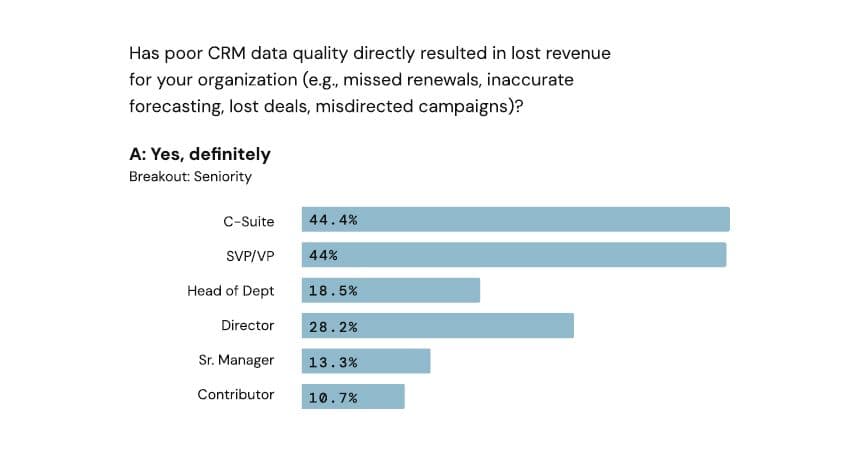
In Validity’s 2026 survey, 62% of organizations reported losing revenue directly because of poor CRM data quality.
AI tools can cut the manual work of maintaining CRM data hygiene, but faster updates only help if they make records more reliable. Once agents act on those records, verification becomes a control on revenue decisions.
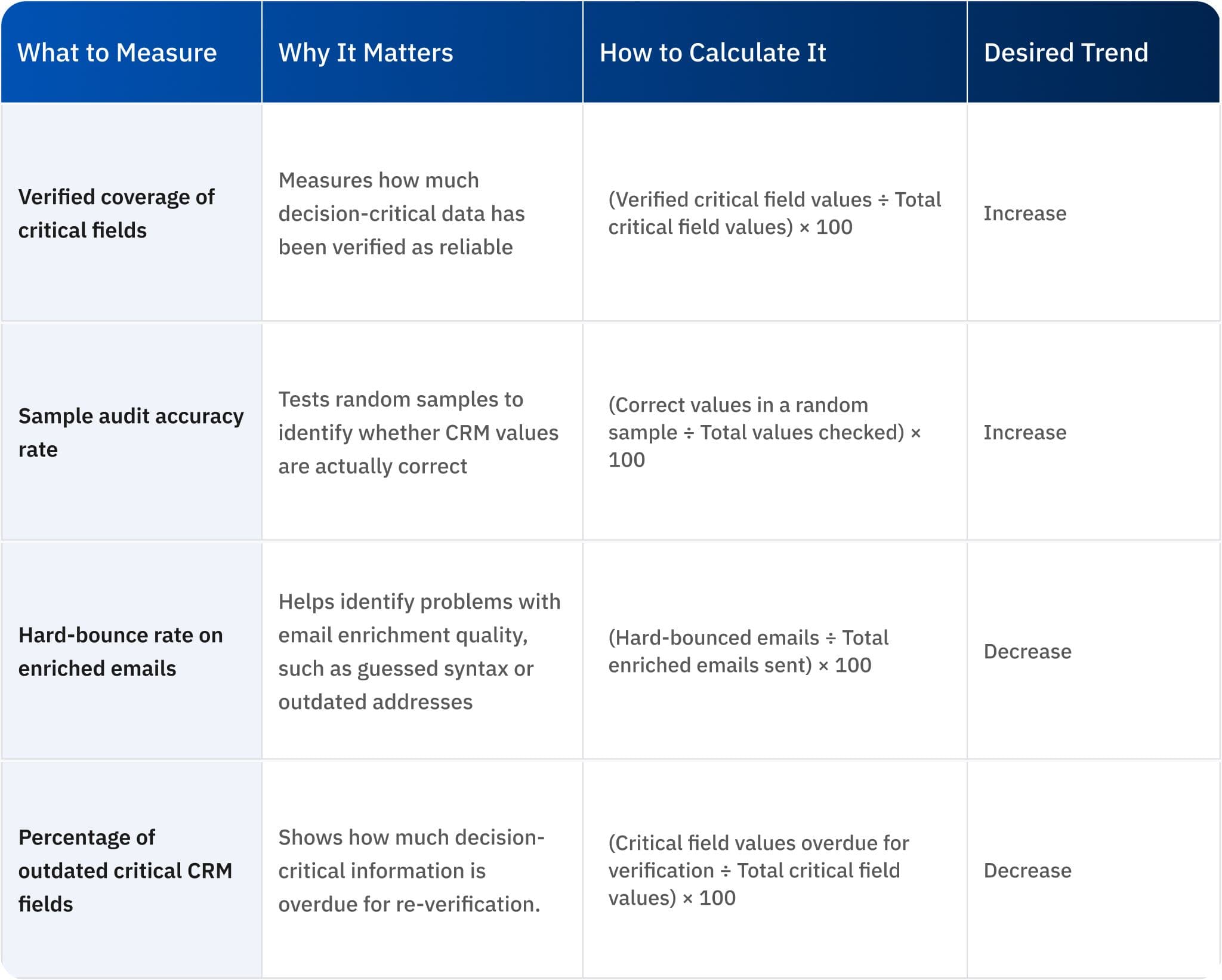
The goal is to keep the speed of AI-assisted maintenance while making the reliability of each critical value visible. To achieve that, you must track: