
Digital Accessibility
Enhanced through ePub3 Conversion Services, with WCAG 2.2 (Level AA) Compliance for a Multi-Format Catalog


An International Publishing Enterprise
The client is a multinational publishing organization with an established presence across the United States, the United Kingdom, and Europe. Its publishing portfolio spans four divisions: academic publishing, educational resources, children’s literature, and trade publishing. Its catalog includes scholarly and professional publications, textbooks and digital learning resources, illustrated children’s books and young adult titles, and mainstream fiction, non-fiction, and specialist-interest publications.

Scalable ePub3 Conversion (With WCAG AA Compliance)
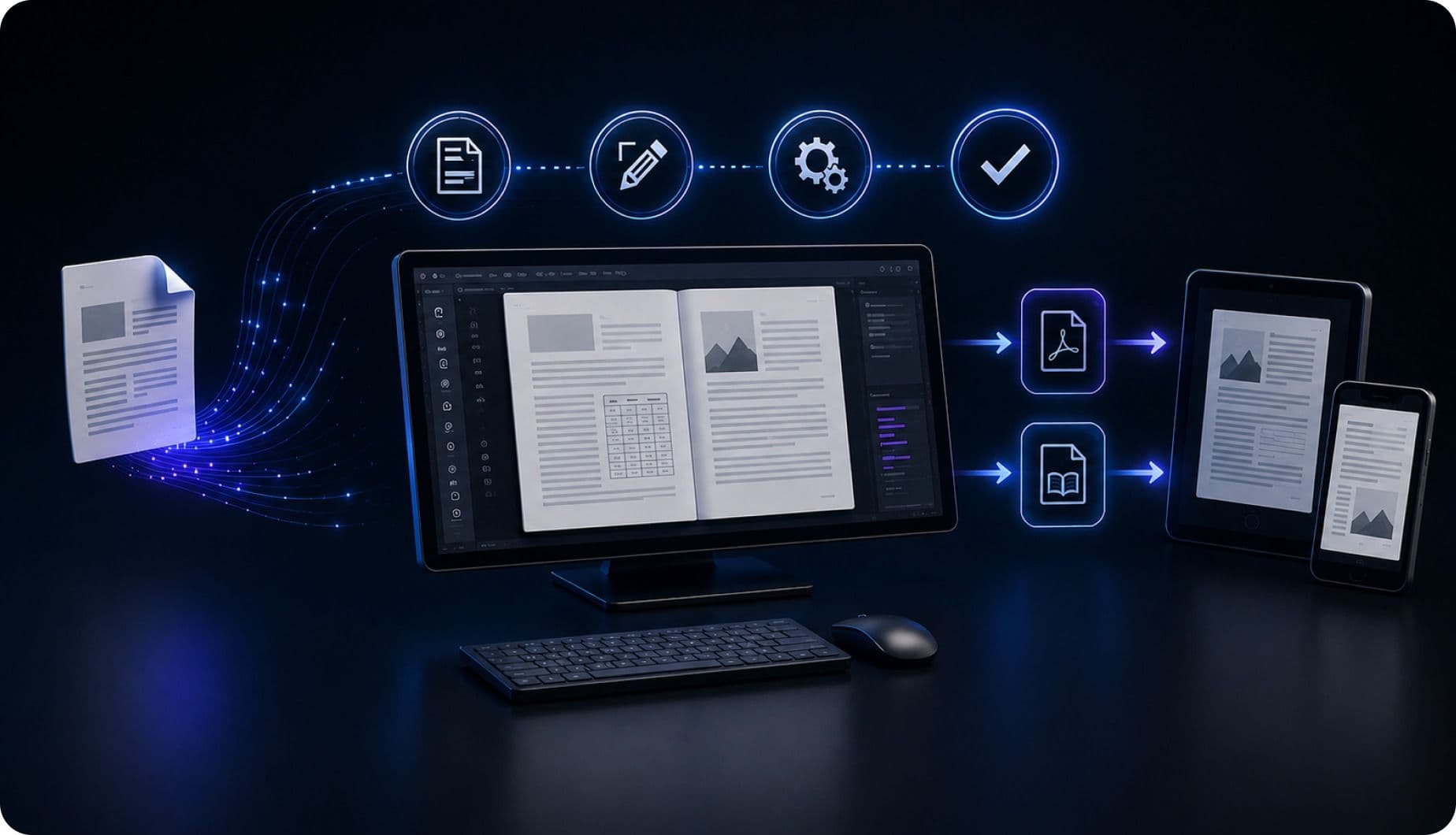
The client required a team to convert 75,000–100,000 pages each month across their four publishing divisions. The resulting files had to meet international ePub3 accessibility guidelines while preserving the distinct layouts, design elements, and reading experience associated with each content category. Beyond file conversion, the client required dependable performance across e-readers, tablets, mobile devices, and assistive technologies. They engaged ePub3 conversion services from Data-Entry-India with accessibility compliance support to combine large-scale processing with consistent rendering, accessible navigation, and preservation of each publication’s design integrity.
STM manuscripts
packed with equations, chemistry notation, and tabular data that demanded technically fluent composition.
Academic volumes
built on strict citation structures, multi-level footnotes, and formal layout hierarchies.
Educational content
published in multiple languages, each carrying its own typographic rules and script considerations.
Trade titles
where creative page design and reading comfort carried commercial weight.
Illustrated books
in which the balance between artwork and text defined the reading experience.
Managing High-Volume, Accessible ePub3 Conversion across Diverse Formats
The project left little room for inconsistency. Errors introduced during ePub3 conversion could affect accessibility, downstream QA, and publication readiness across thousands of files, making quality control critical throughout the conversion lifecycle.
Large-Scale Production
Delivering 75,000–100,000 pages per month required a production model that could handle substantial throughput without compromising quality standards or international publishing deadlines.
Format-Specific Conversion Needs
The client’s catalog included multimedia-based learning content, formula-intensive academic titles, heavily illustrated children’s publications, and reflowable trade books. These variations made a uniform conversion method impractical and required specialized processing for each content type.
Device and Platform Compatibility
Converted ePub3 files had to perform reliably across Apple Books, Google Play Books, Kindle, tablets, smartphones, and assistive technologies. Maintaining consistent navigation, rendering, and usability across these environments added another layer of complexity.
Continuously Changing Compliance Requirements
Our accessibility-first ePub3 conversion workflow had to accommodate evolving international ePub3 accessibility guidelines while also supporting multilingual content distributed across global markets.
ePub3 Conversion Services for Accessible Publishing at Scale
We established a structured ePub3 conversion workflow to manage the client’s varied content portfolio at enterprise scale. The production model combined format-specific conversion, embedded accessibility, multi-stage validation, and flexible resource allocation while maintaining consistent standards across all four publishing divisions.
PROJECT OUTCOMES
Processed 75,000–100,000 Pages Each Month
We ensured consistent high-volume delivery across all four publishing divisions without disrupting scheduled release timelines.
Complied with International Accessibility Requirements
Final ePub3 files met WCAG 2.2 Level AA, EPUB Accessibility 1.1, and relevant ePub3 accessibility guidelines for accessible digital publishing.
Achieved 95%+ First-pass Acceptance Rate
Structured conversion and multi-stage quality checks reduced rework, helping the client accelerate review and publication cycles.



Your Partner for High-Quality, Compliant Publishing at Scale
Our ePub3 conversion service with accessibility compliance helps publishers manage high-volume digital production while maintaining usability, format integrity, and standards alignment. From complex academic content to illustrated and interactive titles, we deliver accessible ePub3 files prepared for major reading environments and assistive technologies.